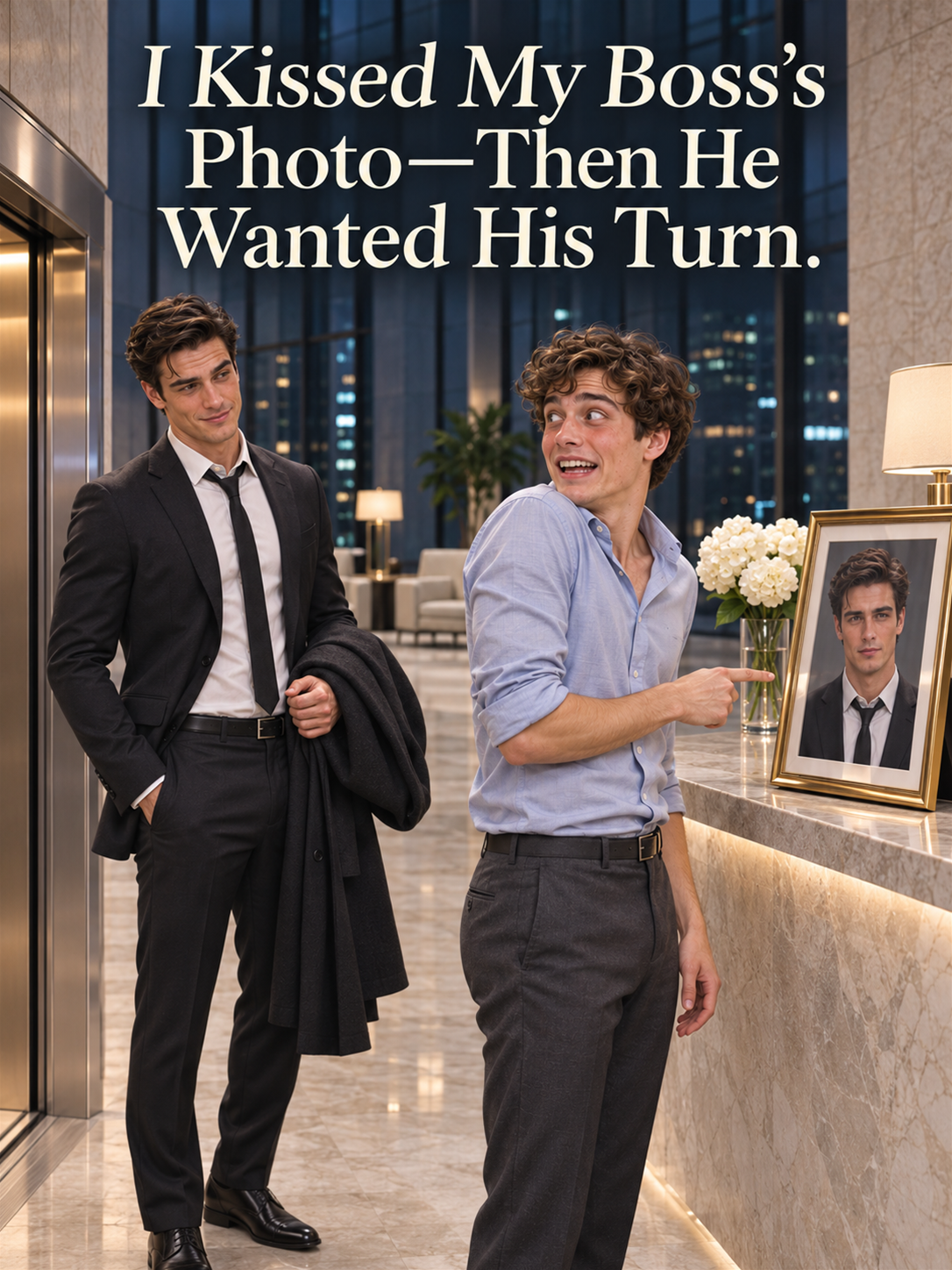
"I Kissed My Boss’s Photo—Then He Wanted His Turn" Chapter 1
The Wrong Man to Kiss
“Should I give you two a moment?”
My mouth was still against the glass when my boss spoke.
I jerked backward, struck the reception desk with my hip, and caught the framed photograph before it tipped off its stand. Apparently, even during the worst moment of my life, I remained committed to protecting company property.
Adrian Vale stood by the elevators with his coat over one arm.
The photograph showed him in a black suit, looking expensive and mildly disappointed in humanity. The original looked exactly the same, except for the amusement beginning at one corner of his mouth.
I had never hated a corner of a mouth more.
“I can explain,” I said.
“I was hoping you would.”
“There was something on the glass.”
His eyes moved to my lips.
“There was,” he agreed.
I set the frame down with unnecessary care.
Six weeks. I had spent six weeks building a proposal to restore a warehouse on Riverton’s waterfront. Affordable workshops downstairs. A training room beside the old loading bay. A future that included the people already living on the street.
At eleven that morning, Adrian had stopped me halfway through my presentation.
“We won’t pursue this.”
That had been all.
By nine that evening, I had completed his travel arrangements, corrected a consultant’s budget, and stayed late to finish a handover packet for the development job I probably wouldn’t get.
Then I had passed his publicity photograph.
I told it that it was arrogant. I told it that its owner confused being difficult to impress with having a personality. I mentioned his habit of loosening his tie at seven and making it everyone else’s problem.
Unfortunately, the photograph had remained handsome throughout.
The kiss had been brief. A small, humiliating farewell to an attraction I intended to kill before breakfast.
“How long have you been standing there?” I asked.
“Long enough to learn that my tie is a management issue.”
I closed my eyes.
“Julian.”
“I’m going home.”
“Come into my office first.”
“I would rather walk into the river.”
His expression shifted. At work, people obeyed him before he finished speaking. I generally did too. This was less because I feared him than because I could usually predict which sensible thing he wanted.
Tonight, I had used up my sensible things.
“Your proposal is on my desk,” he said.
I looked at him. “You rejected it.”
“I owe you an explanation.”
“You owed me one in the meeting.”
The amusement disappeared.
“Yes,” he said. “I did.”
That was irritating. I had a speech prepared for arrogance. I had nothing ready for agreement.
He opened his office and stepped aside.
I went in because I wanted the answer. The photograph, I decided, could fend for itself.
My presentation lay open beneath his desk lamp. Notes crowded the margins. On one page, he had circled my proposed rents and written a question about maintenance reserves. On another, he had drawn an alternative entrance for deliveries.
ADVERTISEMENT
“You read it.”
“All of it.”
“Then why did you act as though I’d wasted everyone’s morning?”
He put his coat on a chair. His sleeves were rolled to his forearms, which felt particularly inconsiderate under the circumstances.
“The warehouse belongs to a family holding company. I inherited an interest in it from my mother.”
I stared at him.
“That seems like information the person proposing to buy it should have.”
“It is.”
“Were you waiting for me to discover it in the gift shop?”
His mouth moved, then settled.
“My mother tried to develop it years ago. The project failed. Every proposal since has become a family argument. When I saw the address, I reacted to the history instead of listening to you.”
Behind him, a small photograph showed a dark-haired woman holding a roll of drawings. I had dusted around it once after a contractor left plaster everywhere. Adrian had quietly moved it out of the work area himself.
“You could have told me,” I said.
“I know.”
“I could have handled a private conversation. What I couldn’t handle was being dismissed in front of a room full of people after you let me prepare for six weeks.”
He looked down at the presentation.
“I’m sorry, Julian.”
He said it without a qualification. No explanation about pressure. No suggestion that I had taken it personally.
I gripped my bag strap less tightly.
“The proposal needs work,” he continued. “These assumptions about repairs are too optimistic. But the tenant model is good. Better than the commercial plan my uncle has been circulating.”
“Then let the development team assess it.”
“I will ask them to.”
“Ask. Don’t tell them to approve it because you feel bad.”
He met my eyes. “You don’t make apologies easy.”
“You should practice more often.”
For a second, he looked almost pleased.
I picked up the presentation. Under the papers sat the transfer application I had submitted to Human Resources three weeks earlier.
“They sent you a copy?”
“For the handover schedule. Your interview is still with development.”
“Good.”
I had wanted that role before tonight. Before the proposal. Before I had learned exactly how long a man could stand behind me without making a sound.
Adrian watched me gather the pages.
“Would you really resign?” he asked.
“Five minutes ago, I would have changed my name and moved to a country without photographs.”
“And now?”
“Now I’d like to go home before this gets worse.”
He walked me to the door. I had spent a year near him, close enough to recognize his cologne on a coat someone else was carrying. Tonight, the space between his shoulder and mine seemed to have developed a temperature.
I reached for the handle.
“One question,” he said.
“About the warehouse?”
“No.”
“Then I strongly recommend saving it.”
He leaned against the edge of his desk, leaving the door clear.
“Was the kiss part of your complaint?”
My fingers tightened around the handle.
“I’ve already explained.”
“The glass. Yes.”
“A perfectly good explanation.”
“It was a terrible explanation.”
I looked back. His gaze was steady, but he had stopped smiling.
“Was it anger,” he asked, “or something else?”
There were several things I could have said. That I noticed whenever he was tired. That I had once stayed twenty minutes after finishing my work because he had finally started telling me a story about his mother. That I knew the particular pause before he laughed, even though he almost never did.
Instead, I said, “Good night, Mr. Vale.”
I escaped before he could answer.
In the elevator, I pressed the button for the lobby three times. It did not descend faster out of sympathy.
My phone vibrated.
Adrian: We’ll discuss the proposal tomorrow.
A second message appeared before I could put the phone away.
Adrian: And the question you didn’t answer, if you’re willing.
I looked at my reflection in the elevator doors.
“You,” I told it, “are going to be very professional.”
My reflection did not look convinced.
ADVERTISEMENT
You May Also Like
-
CompletedChapter 6

The Beast Handler's Seduction
In the depths of Sector Alpha, Dawn is the only human the bio-experiments trust. But after a laboratory glitch, the lines between caretaker and prey blur. Her subjects—a possessive Kraken, a longing Merman, and a lethal Jellyfish—have evolved. They no longer want food; they want her. As forbidden desires clash with cold steel of the lab, Dawn must decide if she is their master, or their ultimate prize.Spirits|Instant Marriage|HE5.2k words5 38 -
CompletedChapter 4
The Mafia's American Rose
After catching her boyfriend in a pathetic act of betrayal, Emily’s study abroad dream shattered. Crying on a moonlit street, she expected pity. What she got was Alessandro Romano—a man whose gaze held the quiet power of a coming storm, and whose name made the city itself hold its breath. He offered her a ride. A conversation. A glimpse into a world of opulent villas, unspoken rules, and loyalty bought with fear. He was everything she should run from: ruthless, commanding, and the undisputed head of the most powerful family in Tuscany. Yet, in his darkness, she found a shelter she never knew she needed. But in Alessandro’s world, attention is a double-edged sword. His rivals notice the American girl who dares to challenge him. His protection becomes a target on her back. When an attempted kidnapping proves the danger is all too real, Emily faces an impossible choice: flee back to her safe, ordinary life, or embrace a love that is as intoxicating as it is lethal. He has one rule: what is his, he keeps. Forever. Now, Emily must decide if she’s willing to become the most coveted prize in a war she never asked to join.Age Gap|Sweet Romance|HE5.1k words5 22 -
CompletedChapter 10
The Heart He Burned
Clara Joy dedicated six years of her life and all her intellect to saving the man she loved, Julian Pierce. She immersed herself in exhaustive research to create an artificial heart that could keep him alive. However, at the moment of her greatest victory, she discovered that Julian saw her only as a pawn in a game of revenge and protection for his true lover, Vivian. He destroyed Clara's laboratory, burned her dreams, and locked her in an attic on her wedding day. But Julian forgot one thing: a broken heart cannot be mended with lies. When Clara disappears into the shadows with a mysterious stranger, Julian realizes that the heart he truly needs is not the metal one, but the one he himself threw away.Age Gap|Substitute Lover|OE12.0k words5 39