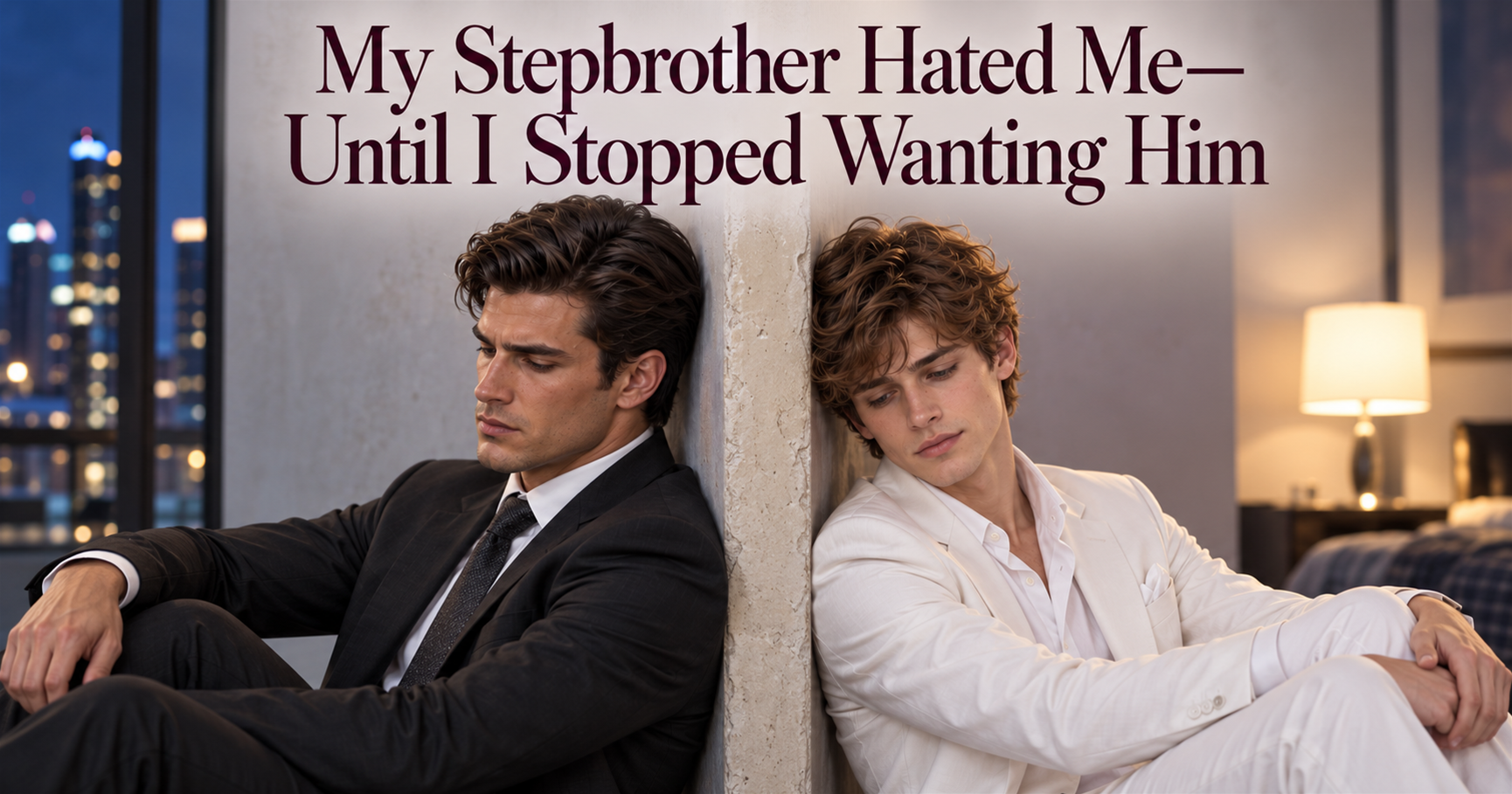
"My Stepbrother Hated Me—Until I Stopped Wanting Him" Chapter 11
A Place at the Table
The first morning in our house, the smoke alarm introduced itself.
I came downstairs to find Nate standing beneath it with a dish towel while two blackened pieces of bread sat in the sink.
For a moment, I just watched.
Then I began laughing.
He looked at me over his shoulder.
"I was making breakfast."
"For a fire inspector?"
"The toaster has settings. They appear decorative."
I took the towel and opened the back door.
Cold air swept into the kitchen. Eventually, the alarm stopped.
We stood looking at the ruined toast.
My face hurt from crying. My mother hadn't called. Nothing important had been repaired overnight.
But Nate was barefoot in his kitchen, looking offended by an appliance, and I loved him so much I couldn't bear it.
"Eggs?" he offered.
"Let's preserve the building. Cereal."
We ate sitting on the kitchen counter because the dining chairs were still wrapped in protective plastic.
At eight thirty, I called Mom.
She answered immediately.
Neither of us spoke for a second.
"I got here safely," I said.
"I know. You texted."
"I wanted to tell you."
She breathed shakily.
"How's your face?"
I looked at the garden through the glass.
"All right."
"I am so sorry, Elliot."
I closed my eyes.
"I heard you last night."
"You shouldn't have had to hear me after I did it."
That was the first thing she said that didn't leave me needing to protect her from it.
We talked for six minutes. She couldn't discuss Nate without her voice tightening. I couldn't discuss home without wanting to cry.
Before we hung up, she asked about my interview.
I told her the date.
She wrote it down.
For then, that was enough.
Life became a collection of small adjustments.
I learned which bus could get me to campus when Nate had an early meeting. He learned not to move my notes, even when they looked like an accident involving paper.
We bought groceries together. He put expensive coffee in the cart. I put it back and showed him the unit price.
"I've been managing budgets for years," he said.
"Apparently nobody's made you buy your own olives."
He looked into the cart, then at me.
"You're very pleased with yourself."
"Trying to contain it."
He smiled at the echo.
Sometimes he reached for my hand in the store and I froze before taking it. He never mistook the hesitation for a refusal. He waited until I looked at him.
I was learning that being chosen could feel frightening after so long expecting the opposite.
He was learning that having me nearby didn't mean he could decide how close I should be.
We got things wrong.
Once, he canceled a dinner with Owen because I had an exam the next morning. He assumed I'd want him home. I assumed he thought I couldn't be left alone.
ADVERTISEMENT
We argued in the kitchen, both too tired to be graceful.
"I thought I was helping," he said.
"Ask me before you reorganize your life around an answer I haven't given you."
He looked at me for a moment.
Then he nodded.
He called Owen back. I revised for my exam. When he came home, he brought the noodles I'd asked for, and we ate them out of the cartons.
It wasn't a dramatic reconciliation.
It was better practice.
I got the summer placement.
The coordinator offered me a room on campus. I accepted it for the weeks with early starts, keeping the coastal commute from swallowing my days.
When I told Nate, he smiled and asked what size sheets I needed.
I stared at him.
"What?" he asked.
"Nothing."
He put his cup down.
"Elliot."
"You don't mind?"
"I'll miss you during the week. That's not the same as minding."
I kissed his cheek, quick and grateful.
"You're getting dangerously reasonable."
"Don't tell anyone at work."
He helped me move into the small campus room in June. Ben arrived carrying a plant that looked uncertain about its future.
"Low maintenance," he said. "In theory."
We put it on the windowsill.
When Nate left, I walked him downstairs.
"Friday?" he asked.
"Friday."
He kissed my forehead and went to his car.
I watched him leave without feeling abandoned.
That was new too.
Mom began calling on Sundays.
At first, she asked only about classes and meals. Then one evening, while I was telling her about a broken cabinet hinge, she asked, "Did Nate fix it?"
"He tried."
"Meaning?"
"It opens beautifully. It no longer closes."
A startled laugh came down the line.
I stood very still until she'd finished.
Three weeks later, she asked if she could visit.
"Both of us will be here," I said.
"I understand."
I cleaned for two hours. Nate watched me rearrange the same cushion three times, then gently took it out of my hands.
"She knows you live here."
"She doesn't know I live here with inadequate cushions."
He put it back on the sofa.
"Tea?"
"For me or her?"
"I'm considering both."
Mom arrived with a cake from the bakery we'd gone to when I was small.
She hugged me at the door, carefully, as though I might still be deciding whether to step away.
I hugged her back.
Nate stayed in the kitchen until she came in.
"Rachel."
"Nathaniel."
The formality hurt. I let it hurt without rushing to soften it.
Over tea, she asked about the placement. I showed her photographs from the department. She looked around the living room and noticed the little wooden bridge on the shelf.
"Did you make that?"
"We did."
Nate glanced at me.
It had taken two evenings, one argument over the instructions, and the discovery that he still used too much glue.
Mom looked at it for a long moment.
ADVERTISEMENT
Then she said, "It's lovely."
Afterward, Nate went to get more hot water.
Mom rested her hands around her cup.
"I keep thinking of you as the little boy I brought into that house," she said.
I looked at her.
"I know."
"I thought I had made a safe place for you. Then I saw something I didn't understand, and I was frightened."
My shoulders tightened.
She noticed.
"That doesn't excuse what I did. Any of it."
I breathed out slowly.
"No."
"And I asked you to be patient with him far too often. I thought if everyone kept trying, we'd become the family I wanted."
Her eyes filled.
"I didn't ask enough about what it cost you."
For a moment, I couldn't speak.
Then I told her about the doors. About feeling responsible for keeping dinners pleasant. About learning to turn disappointment into jokes because it made everybody less uncomfortable.
She listened.
When I finished, she reached across the table. I let her take my hand.
"Are you happy here?" she asked.
I looked toward the kitchen.
Nate was standing at the counter, deliberately giving us time.
"Yes," I said. "Not every minute. But yes."
She nodded.
Before she left, she thanked him for the tea.
It wasn't forgiveness for everything. It was a sentence addressed to him without anger.
We let it be small.
Victor took longer.
He continued working with Nate, which I knew because Nate came home tired in a particular way after meetings. He never gave me an account designed to make me hate his father.
In August, Victor sent me a message asking about the placement.
I answered.
In September, he asked whether I'd meet him for lunch.
We sat across from each other in a quiet restaurant. He looked older than I remembered, though it had only been months.
"Your mother says you're doing well."
"I am."
He folded his napkin once.
"I don't know how to understand this yet."
I kept my hands in my lap.
"I'm not asking you to pretend."
"I thought you'd both thrown away the family."
"We wanted to stay part of it. You told us the condition."
He looked down.
For a while, the only sound was somebody stacking plates behind the counter.
"I did," he said finally.
It wasn't eloquent. It was the beginning of an honest conversation.
We had several more before he visited the house.
The first time, he stayed forty minutes. The second time, he helped Nate repair the cabinet properly. I listened to them disagree about screws from the next room and found myself crying over a stack of lecture notes.
Not because everything was fixed.
Because they had come back to try.
By the following spring, we could sit at a table together without rehearsing every sentence beforehand.
There were things we still discussed carefully. There were moments when Mom looked sad at a memory nobody else could see. Love hadn't turned us into people without history.
But Nate no longer went silent when his mother was mentioned. Rachel no longer asked me to translate his moods. Victor sometimes called to invite us, using the plural without pausing.
We were building something different from what they had planned.
It took more time than a party.
A year after we left, Nate and I held a small ceremony in our garden.
No ballroom. No announcement designed for anyone else's benefit. Just vows we had written ourselves, two rings, and people we'd asked to witness the life we were choosing.
Ben complained about having to wear a tie. Owen brought flowers and, with the easy kindness of someone who had long since moved on, helped Martha arrange the chairs.
Mom arrived with Victor. She straightened my collar and pressed her lips together until I told her she was allowed to cry.
"So are you," she said.
"Terrible news."
She laughed through it.
Nate waited near the old apple tree.
When I reached him, he looked at me with an expression I could finally recognize without inventing a safer explanation.
He took my hands.
His voice shook on my name.
"Elliot, I used to believe keeping people outside was the same as keeping myself safe. You deserved better than the person I was. You deserve more than a promise that I'll never make another mistake."
He looked at our joined hands, then back at me.
"I promise I'll listen when you tell me I've made one. I'll keep asking instead of assuming. And wherever your life takes you, I'll make room for you to come home as yourself."
I had planned a very composed response.
It abandoned me immediately.
"I used to think loving you meant waiting quietly enough," I said. "Then I left, and you finally learned to knock."
A laugh moved through our small audience. Nate smiled with wet eyes.
"I won't promise to be easy," I continued. "I will question your grocery choices. I will continue telling everyone about the toaster. But I promise you'll never have to wonder whether I chose this. I did. I do."
He squeezed my hands.
"I love you," I said. "And I like the life we're making. Even the difficult parts."
When we exchanged rings, his fingers trembled.
I leaned closer.
"Nervous, Mercer?"
"Terrified, Hayes."
"Good. I'd hate to be the only one."
He laughed, and when he kissed me, nobody asked us to move apart.
Later, after the chairs had been folded and the last car had left, we stood in the kitchen beneath the light he'd finally remembered to replace.
Two mugs waited on the counter.
He handed me one.
"Tea?" I asked.
"Rachel's instructions. Apparently we're still incapable of choosing our own bedtime."
I smiled into the steam.
He touched the ring on my hand, as though he hadn't quite become used to seeing it there.
"Happy?" he asked.
I looked through the open doorway at my books beside his, the blue blanket over the sofa, the crooked little bridge on the shelf.
Then I looked at him.
"Yes."
He bent his head and rested his forehead against mine.
For years, I'd stood outside his door hoping to be invited in.
Now, when he reached for my hand and said, "Come on. Let's go home," I could laugh and remind him we were already there.
The End