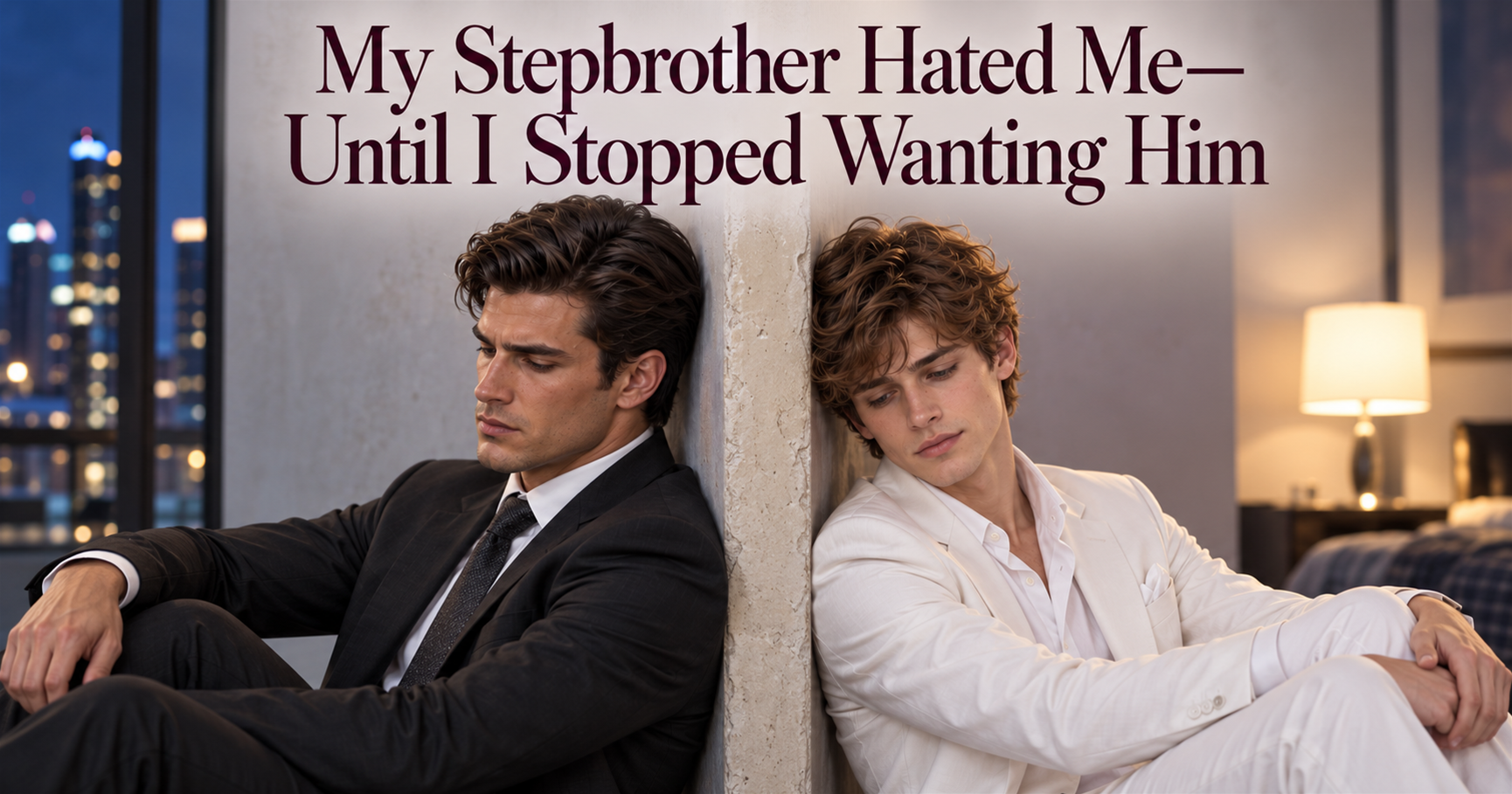
"My Stepbrother Hated Me—Until I Stopped Wanting Him" Chapter 6
The Man at the Bakery Door
On Saturday morning, Nate was standing outside the bakery with a paper cup in each hand.
I saw him through the apartment window and nearly dropped Ben's watering can.
"There's a tall problem downstairs," I said.
Ben peered past me.
"Expensive coat. Terrible posture. Yes, that looks like yours."
"He isn't mine."
"Then tell him. He's depressing the pastries."
My phone rang before I could answer.
"I'm downstairs," Nate said.
"I noticed."
"May I see you?"
The question steadied something in me.
"I have plans at noon."
"I know. You said you were helping Tessa."
He remembered.
I shut my eyes briefly.
"Give me ten minutes."
"Take your time."
Ben handed me a clean sweater without commentary, which was how I knew he was taking this seriously.
Outside, Nate offered me one of the cups.
"Decaf," he said. "Before you accuse me of trying to interfere with your recovery."
"I've been well for weeks."
"I'm adjusting slowly."
I accepted it.
We walked toward a small park. The benches were damp, so we stayed on the path, keeping an awkward amount of space between our shoulders.
"You could have called first," I said.
"You could have said no."
"Those aren't the same thing."
He considered that.
"You're right. I wanted to come. I should have asked before I did."
It was difficult to argue with him when he stopped fighting the obvious.
"What did you want to say?"
He stopped near a bare-limbed tree.
"That I miss you. And that I understand that's not a reason for you to come back."
I looked at the lid of my coffee.
"Good beginning."
He gave a brief, nervous laugh.
I'd never heard him nervous before.
"I'm trying very hard not to get this wrong."
"You've had practice doing the opposite."
"Years. I'm exceptionally qualified."
I looked up despite myself.
There he was: the man who occasionally made a joke when nobody was expecting one, then seemed surprised by how much I enjoyed it.
His expression became serious.
"At the party, I asked you to give me time because I was afraid. Of Dad. Of Rachel. Of what it would mean about the way I've treated you."
"What does it mean?"
"That I made you feel unwanted, and then expected you to trust me when I wanted something."
He said it without looking away.
I had spent so long trying to explain him to myself that hearing him do the work felt almost disorienting.
"I don't know how to be certain you won't change your mind," I said.
"I can't hand you certainty in a coffee cup. I can stop asking you to live with the consequences while I avoid them."
A dog ran past us carrying a branch much larger than its ambitions should have allowed. Its owner called a name that the dog ignored.
I watched them because I needed a moment.
ADVERTISEMENT
"You were so angry when I came into your life," I said. "Sometimes I still feel like I'm about to apologize for wanting to be near you."
His face changed.
"Don't."
"It's not a switch."
"I know."
This time, the words didn't sound like a way to end the conversation.
He looked down at his cup.
"I remember you asking about the bridge."
I went still.
"What?"
"The model in Dad's study. You wanted to know whether it could hold a toy car."
I hadn't realized he remembered any of it.
"You shut the door."
"I did."
"What happened to it?"
"It collapsed. Bad construction."
The laugh escaped before I could stop it.
His mouth softened.
"I wanted to tell you that," he said. "You weren't missing anything extraordinary behind the door. Just a very unpleasant person with bad glue."
I looked away because my eyes were stinging.
"I would've helped pick it up."
"I know you would."
We walked again.
At a street crossing, he moved to the side nearest the traffic. I noticed; he noticed me noticing.
"Don't," I said.
"Don't walk?"
"Turn into somebody charming. It's badly timed."
He smiled properly then.
It was almost unfair.
"I'll try to remain difficult."
We stopped at a secondhand bookshop because it had started raining and because I was not ready to go back upstairs.
He followed me through shelves too narrow for his shoulders. I found a battered collection of essays. He picked up a crime novel, read the first page, and immediately looked offended.
"What?" I asked.
"He's going into the basement."
"Sometimes people keep things there."
"The lights are out and his brother's missing."
"Perhaps he wants a matching experience."
He laughed. The shopkeeper glanced over.
I looked at the book in my hands, smiling like an idiot.
This was the problem. Not his face. Not the money. This quiet, unexpected ease I kept finding beneath all the damage.
At the counter, he reached for his wallet.
"I've got mine," I said.
He stopped and let me pay.
Outside, the rain had thinned to mist.
"Claire deserves an honest conversation," he said.
The warmth in me contracted.
"Yes."
"I'm ending the engagement."
I looked at him.
He didn't offer the sentence like a gift that required a reward.
"I need to speak to her privately. Properly. She's done nothing to deserve this."
"I know."
"I should have done it before I came here."
"Yes," I said again.
His eyes stayed on mine.
"I'm not asking you to wait in the meantime."
I folded my arms, partly against the cold.
"That's good, because I'm quite busy."
He glanced at my book.
"Basement research?"
"Avoiding emotionally unavailable businessmen. There's a waiting list."
His laugh was small and pained.
"Fair."
We reached the bakery just before eleven.
He stood facing me beneath the awning. People moved around us, buying bread, checking their phones, living lives that didn't feel as though they were balanced on one word.
"May I come again?" he asked.
I could have said not yet.
Instead, I said, "Call first."
He nodded.
My scarf had twisted under the strap of my bag. He noticed and lifted his hand, then paused.
I caught his wrist before he could lower it.
For one breath, neither of us moved.
I put his hand against my cheek.
His eyes closed.
It was such a simple thing. I had imagined complicated declarations, impossible promises. In the end, what nearly broke me was the care with which he held still.
"Elliot," he said.
"I know."
I let go before either of us could turn the moment into an excuse to postpone the harder part.
He stepped back.
"I'll call you."
Upstairs, Ben looked up from his laptop.
"How was the coffee?"
"Complicated."
"Terrible roast."
I sat beside him on the sofa.
After a while, my phone lit up.
NATE: You left your receipt in my book.
ME: A thrilling development.
NATE: I'm treating it as permission to see you again.
ME: Call first, Mercer.
NATE: Yes, Hayes.
I smiled at the screen until Ben pushed a cushion into my face.
"Disgusting," he said affectionately.