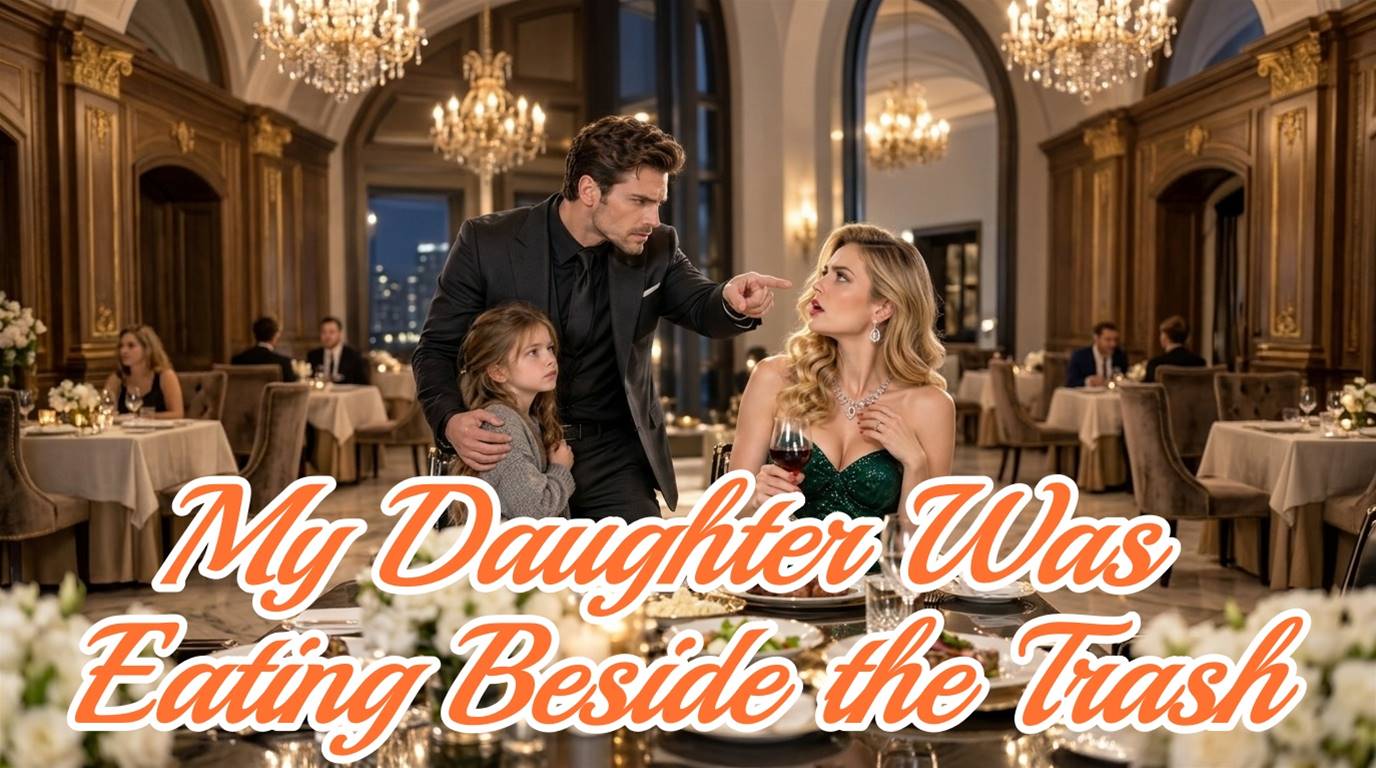
"My Daughter Was Eating Beside the Trash" Chapter 10 — You Took Her Mother. You Won't Take Her Father.
Victoria was halfway through the hotel lobby when two detectives approached her.
“Victoria Whitmore?”
She stopped, one hand wrapped around the handle of a designer suitcase.
“I'm checking out.”
Detective Carter showed his identification. “We have a warrant for your arrest.”
For one extraordinary second, she smiled as if this were an embarrassing misunderstanding that money could fix.
“Do you know who my husband is?”
“Yes,” Carter said. “And this isn't about his opinion of you.”
He told her the charges listed in the warrant and advised her of her rights before questioning.
The lobby fell quiet. A guest near the elevators lowered his phone when an officer asked him to give them space.
Victoria's smile vanished.
“This is Richard's fault,” she snapped. “He's lying.”
“You can discuss your position with your attorney.”
She looked toward the glass doors, searching for someone who might intervene. Nobody did.
Richard was taken into custody separately. His cooperation had not erased his role in the conspiracy.
By noon, the arrests were on every local news site. Whitmore Development issued a statement confirming its cooperation with investigators and the ongoing review of fraudulent payments.
Nathan refused interview requests.
He sat with Daniel in a conference room, listening to the prosecutor explain what the evidence could establish and what still had to be proved in court.
Claire's recording was powerful. The financial trail, vehicle evidence, recovered messages, and testimony supported it. But Nathan knew better than to confuse an arrest with a verdict.
“What happens to Emma?” he asked.
Daniel turned a page. “We continue the family court proceedings. Victoria has no right to use the criminal case to pressure your daughter. We'll ask for appropriate protective orders.”
“And the trust?”
“The court has already blocked disputed transfers. We're tracing the rest.”
Nathan looked down at his hands. “I want every dollar they took from her returned.”
“We'll pursue everything the evidence supports.”
The divorce was still pending when Victoria tried to send Nathan a letter through her lawyer.
Nathan had once imagined revenge as a single dramatic moment: Victoria losing her mansion, Richard losing his business, everyone who ignored Emma finally forced to look at her empty plate.
Instead, justice looked like folders, sworn statements, and waiting rooms. It looked like Emma's therapist reminding him that a child's healing did not follow a court calendar.
He learned to keep his anger outside her bedroom door. When she asked for a bedtime story, he read one. When she asked why adults lied, he told her that some people made harmful choices and that she was never responsible for them.
The truth was becoming public. Emma's life, Nathan decided, would remain her own.
Daniel read it first.
It began with an apology, then blamed Richard, Nathan's long absences, and Emma's supposed disobedience. It ended by asking Nathan to remember the woman he had loved.
Nathan read the last line without changing expression.
ADVERTISEMENT
“Do you want to respond?” Daniel asked.
“Yes. Through you. Tell her not to contact Emma.”
“Anything else?”
Nathan placed the letter facedown.
“She took Claire from us. She doesn't get another minute of my daughter's childhood.”
At school, Emma heard whispers about the arrests. Sarah Mitchell intercepted an older student's question before it reached her.
Later, Emma asked Nathan whether Victoria would come back.
“Not to our home,” he said. “Adults are handling what happened. Your job is to be seven.”
“What does being seven mean?”
“Reading books. Making terrible jokes. Asking for dessert before dinner.”
Emma considered this. “Can I have dessert before dinner?”
“Nice try.”
She laughed so suddenly that Nathan laughed too.
The months that followed were not simple. Investigators prepared their case. Lawyers exchanged records. Nathan attended hearings and learned how slowly justice moved when every accusation had to be tested.
Victoria's former friends disappeared from her visitor lists. Her charity board removed her after reviewing its policies. The social invitations she had treated as proof of her importance stopped arriving.
Richard's consulting contracts collapsed as clients examined the fraudulent vendor arrangements. His remaining assets became subject to civil claims and lawful recovery proceedings.
Neither sibling could buy back the silence that had protected them.
At a preliminary hearing, Nathan saw Victoria across the courtroom. She wore a plain jacket instead of the jewel-colored dresses she once favored.
She leaned toward her attorney, then looked directly at Nathan.
He did not look away.
Afterward, she passed close enough to speak before a deputy directed her onward.
“Nathan,” she whispered. “I did love you.”
He answered quietly, so only she could hear.
“You taught my daughter she had to earn a place at her own table.”
Victoria's mouth opened.
“You took her mother,” he said. “You won't take her father.”
The deputy escorted her away.
Nathan felt no sudden triumph. He felt the weight of everything Emma had survived. Then he walked outside into the daylight and called home.
Margaret answered.
“Is Emma all right?”
“She's arguing with the dog about a sock.”
“We don't have a dog.”
“We do now. Apparently you agreed to discuss adopting one.”
Nathan blinked. “I said we could discuss it.”
Margaret laughed. “That's all she needed.”
Months later, the criminal cases reached trial after extensive pretrial proceedings. The prosecution presented authenticated records, expert testimony, Richard's statements subject to cross-examination, and Claire's recorded warning under the court's evidentiary rulings.
Richard and Victoria each tried to shift responsibility. Their own messages made that difficult.
Nathan testified about the company records and the circumstances in which the doll and its contents had been found. He did not put Emma in front of cameras or use her pain as a public performance.
When the jury returned guilty verdicts on the principal charges, Nathan closed his eyes.
The court would determine sentences later. The civil recovery actions would continue. Nothing could bring Claire back.
But the truth no longer belonged to the people who had buried it.
Outside the courthouse, reporters called his name.
Nathan gave one statement.
“Claire Whitmore was a mother who tried to protect her child. My daughter deserves privacy, safety, and a future that isn't defined by what was done to her.”
He refused further questions and went home.
Emma was waiting in the kitchen with a drawing. It showed three people holding hands beneath a bright yellow sun.
“That's you and me,” she said, pointing. “And Mommy, because I still think about her.”
Nathan knelt beside her. “So do I.”
Emma studied his face.
“Daddy, did Mommy die because she was trying to protect me?”
The question landed harder than any courtroom testimony.
Nathan drew her close. He knew the answer mattered, but so did the way he gave it.
“Mommy was trying to keep our family safe,” he said. “What happened was the fault of the adults who hurt her. Never yours.”
Emma held him tightly.
“Did she know I loved her?”
“Oh, sweetheart.” Nathan kissed the top of her head. “She knew.”
That night, Daniel called with news that Helen Mercer had cleared the release of Claire's personal letter to Emma.
Nathan stood outside his daughter's bedroom holding the sealed envelope.
Tomorrow, he would help her hear the words her mother had saved.
ADVERTISEMENT
You May Also Like
-
CompletedChapter 16

The Profiler's Broken Silence
Clara was the most brilliant criminal profiler in the city, gifted with the power to expose any monster with her sketches. But her world shatters when her own husband, Sebastian, betrays her to protect the man who destroyed her family. After her hands are broken and her loved ones are gone, Clara realizes that love was just a gilded cage. Now, she doesn't want his apologies—she wants his downfall.Glow-Up|Possessive Love|Second Chance|BE17.9k words5 91 -
CompletedChapter 20
Tainted Crown: A Tale of Sin and Sovereignty
Born in the freezing mud of the Lowlands, Solene learned early that survival has a price. When her mother trades their poverty for a place in Earl Dagon’s opulent mansion, Solene steps into a world of sparkling gems and deadly secrets. Behind her mask of a "Saint," she orchestrates a symphony of revenge, turning the imperial family into her puppets. The Prince, the Empire’s Golden Sun, thinks he can save her—but he is just another pawn in her cold-blooded game.Glow-Up|OE37.1k words5 75 -
CompletedChapter 12
Unloving You: A Rebirth of Letting Go
In his past life, Julian spent ten years chasing a woman who saw him only as a burden. He ruined her happiness, and in the end, she died saving him. Given a miraculous second chance, Julian wakes up on the very day of his 56th failed confession. This time, instead of flowers and pleading, he hands the bouquet to the man she truly loves. "I'm letting you go, Scarlett," he whispers. But as Julian packs his bags to disappear forever, the cold and powerful Scarlett begins to feel a suffocating panic. Why is the boy who once worshipped her now looking at her with such indifferent eyes?Glow-Up|Possessive Love|Fake Relationship|OE17.0k words5 50 -
CompletedChapter 13
The 999th Night: From Lovers to Strangers
After 999 nights of passion, Selina thought she was Julian's world. But to him, she was just a "placeholder" to kill time until his true love, Nina, returned. When a car crash forced him to choose, he protected Nina without a second thought, leaving Selina bleeding in the rain. Heartbroken and finally awake, Selina decides to vanish from his life forever. She books a one-way ticket across the ocean, leaving behind a decade of devotion. When Julian finally realizes that he can't live without his "shadow," all he finds is an empty house and a cold goodbye.Possessive Love|Second Chance|OE18.7k words5 43 -
CompletedChapter 12
Breaking the Ties of Love
Five years of marriage, five years of hell. Clara loved Xavier with every fiber of her being, but to him, she was nothing but a criminal—the monster who supposedly ruined his lover and crippled his sister. Locked away in a cold basement, Clara endured endless torment as penance for sins she never committed. But when the truth finally surfaces, Xavier falls to his knees, begging for a second chance. Too late. The Clara who loved him is already dead, and she is ready to walk into the darkness to escape him forever.Possessive Love|Love After Marriage|Second Chance|BE16.6k words5 41 -
CompletedChapter 11
After the Divorce, Hearts Came Running
Clara spent five years trapped in a cold, touchless marriage with Julian, the world-renowned surgeon who claimed he couldn't stand physical contact. But on their anniversary, after traveling thousands of miles to surprise him in Edinburgh, she found him tenderly caring for his ex-lover in the rain. At that moment, the rose in her heart finally withered. Julian chose his past; Clara chose her freedom. But when she returned home and erased every trace of him, the man who once couldn't stand her touch began to beg for a second chance.Fake Relationship|OE16.2k words5 32 -
CompletedChapter 10
The Heart He Burned
Clara Joy dedicated six years of her life and all her intellect to saving the man she loved, Julian Pierce. She immersed herself in exhaustive research to create an artificial heart that could keep him alive. However, at the moment of her greatest victory, she discovered that Julian saw her only as a pawn in a game of revenge and protection for his true lover, Vivian. He destroyed Clara's laboratory, burned her dreams, and locked her in an attic on her wedding day. But Julian forgot one thing: a broken heart cannot be mended with lies. When Clara disappears into the shadows with a mysterious stranger, Julian realizes that the heart he truly needs is not the metal one, but the one he himself threw away.Age Gap|Substitute Lover|OE12.0k words5 29 -
CompletedChapter 6
The Beast Handler's Seduction
In the depths of Sector Alpha, Dawn is the only human the bio-experiments trust. But after a laboratory glitch, the lines between caretaker and prey blur. Her subjects—a possessive Kraken, a longing Merman, and a lethal Jellyfish—have evolved. They no longer want food; they want her. As forbidden desires clash with cold steel of the lab, Dawn must decide if she is their master, or their ultimate prize.Spirits|Instant Marriage|HE5.2k words5 26 -
CompletedChapter 4
The Mafia's American Rose
After catching her boyfriend in a pathetic act of betrayal, Emily’s study abroad dream shattered. Crying on a moonlit street, she expected pity. What she got was Alessandro Romano—a man whose gaze held the quiet power of a coming storm, and whose name made the city itself hold its breath. He offered her a ride. A conversation. A glimpse into a world of opulent villas, unspoken rules, and loyalty bought with fear. He was everything she should run from: ruthless, commanding, and the undisputed head of the most powerful family in Tuscany. Yet, in his darkness, she found a shelter she never knew she needed. But in Alessandro’s world, attention is a double-edged sword. His rivals notice the American girl who dares to challenge him. His protection becomes a target on her back. When an attempted kidnapping proves the danger is all too real, Emily faces an impossible choice: flee back to her safe, ordinary life, or embrace a love that is as intoxicating as it is lethal. He has one rule: what is his, he keeps. Forever. Now, Emily must decide if she’s willing to become the most coveted prize in a war she never asked to join.Age Gap|Sweet Romance|HE5.1k words5 13