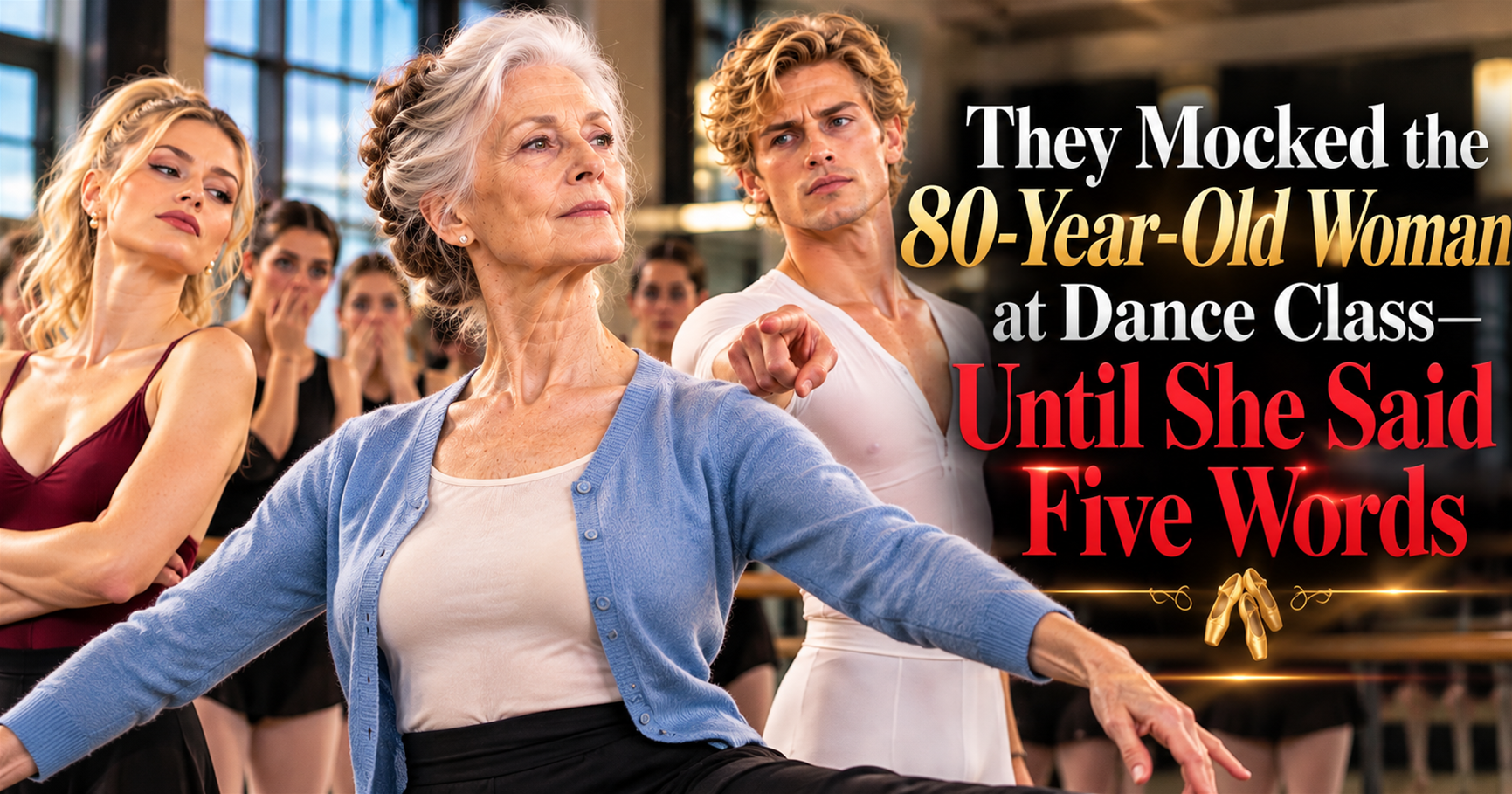
"They Mocked the 80-Year-Old Woman at Dance Class—Until She Said Five Words" Chapter 4 — THE WOMAN RICHARD STERLING FEARED
Eleanor's apartment smelled of lemon tea and the lavender soap her late husband had always bought her.
She set her canvas bag on the kitchen table, lowered herself into a chair, and allowed her hands to tremble.
Only now, alone, did she feel the full weight of the afternoon.
She had imagined returning to the old studio hundreds of times. Sometimes she pictured herself entering unnoticed and touching the wooden floor. Sometimes she imagined a young dancer asking about the past. She had never imagined standing before a room full of strangers while they laughed at her age.
The humiliation stung more than she wanted to admit.
A key turned in the lock.
“Mom?”
Her son, Daniel Whitmore, entered carrying groceries. At forty-eight, Daniel had his father's dark eyes and Eleanor's habit of asking difficult questions in a calm voice. He was an attorney who spent most of his time resolving disputes for clients and almost none of it investigating his own family's history.
“You went out today,” he said, noticing her shoes. “How was your walk?”
“I visited my old dance studio.”
Daniel set down the bags. “The one you told me about when I was a kid?”
“Yes.”
He smiled. “Did you get inside?”
“I did.”
Something in her voice made him sit across from her.
“What happened?”
Eleanor told him everything: the laughter, Adrian's demonstration, the choreography sheet, and Catherine's arrival with a security officer.
By the time she finished, Daniel's face had gone red.
“They treated you like that?”
“They didn't know me.”
“That doesn't excuse it.”
“No,” she said. “It doesn't.”
He stood. “I'm calling the conservatory.”
“Sit down, Daniel.”
“Mom—”
“Please.”
He sat, reluctantly.
Eleanor went to the bedroom and returned with a wooden box. Its brass latch had darkened with age. She placed it between them and opened it.
Inside were ballet slippers, photographs, newspaper clippings, and a notebook bound with a faded ribbon. Daniel lifted one of the photographs. His mother was young, her dark hair pulled back, one arm extended toward a window.
“I've never seen this.”
“There was a time when I didn't want to see it, either.”
She explained how she had created Winter Flight, how Richard had promised her a credit, and how her career had faded after she challenged him.
Daniel listened without interrupting. He knew his mother had danced professionally before he was born. He had never understood that she had also been a choreographer, or that the loss of her career had been tangled with someone else's rise.
“Why didn't you tell me?” he asked.
“Your father knew. He wanted me to fight. But when you were little, I wanted our home to be a place where I wasn't always angry.”
“You could have trusted me.”
“I do trust you.”
She reached across the table and touched his wrist.
“I just didn't want that man to take any more years from us.”
ADVERTISEMENT
Daniel opened the notebook. The pages were covered with counts, arrows, and tiny sketches of bodies in motion. Dates ran across the margins. Some pages carried the title Winter Flight. Near the back, a separate section was marked The Last Winter.
“What's this?” he asked.
“Another dance. One I never finished.”
He turned a page and found a folded envelope tucked into the binding.
“Mom, did you know this was here?”
Eleanor stared at it.
The paper was yellowed. Her name appeared on the front in familiar handwriting.
She had hidden the letter decades earlier and then forgotten exactly where she'd placed it.
“Richard wrote that,” she whispered.
Daniel unfolded the sheet carefully.
It was dated March 1972. The letter thanked Eleanor for her work developing Winter Flight and promised that her choreographic contribution would be acknowledged in future printed materials. Richard had signed his name at the bottom.
Daniel read it twice.
“This matters,” he said.
“Does it prove he stole everything?”
“Not by itself. But it contradicts the idea that you had no creative role.”
He looked at the other materials. “We'd need to establish which documents are authentic, what agreements existed, and what kind of correction is still possible. After fifty-four years, there may be serious legal barriers.”
Eleanor nodded. She had never expected a simple courtroom victory.
“I don't want a fortune,” she said. “I want them to write my name beside the dance.”
Daniel held the letter as though it were fragile glass.
“Then we start by documenting everything.”
Across Manhattan, Adrian sat alone in his office with a photocopy of the 1972 repertory sheet. He had called the conservatory's records administrator, who told him that several boxes from that period were missing from the digital inventory.
“Missing how?” Adrian asked.
“Some were transferred years ago. Others may have been discarded during a storage move. I can't tell you more without authorization.”
He tried Catherine's number. She did not answer.
When he returned to the studio, he found Emily waiting by the door.
“I wanted to say something earlier,” she told him.
“Then why didn't you?”
“Because you were laughing, too.”
Adrian looked away.
He had not actually laughed. But he had performed the routine to make Eleanor feel small, and he knew Emily was right about the spirit of it.
“I know,” he said.
Emily hesitated. “Do you think she's telling the truth?”
“I think there's enough to ask questions.”
“And if Catherine doesn't want us to?”
“Then maybe that's another question we should ask.”
That evening, Catherine visited her father at his Upper East Side residence. Richard Sterling sat in a high-backed chair overlooking the city. At eighty-four, he remained imposing, though age had thinned his face and slowed his movements.
Catherine laid the photocopied repertory sheet on the table.
“She found the studio,” she said.
Richard glanced at the initials and looked away.
“I told you to keep those records private.”
“We can't pretend she doesn't exist.”
“She left the company decades ago.”
“That isn't an answer.”
Richard's voice sharpened. “You have no idea what it took to build that institution.”
“Then tell me.”
He stared out at the lights of Manhattan.
For the first time in her adult life, Catherine saw her father look frightened rather than angry.
“Eleanor was talented,” he admitted. “More talented than anyone wanted to acknowledge.”
Catherine's throat tightened. “Did she create Winter Flight?”
He did not reply.
At Eleanor's apartment, Daniel finished scanning the letter and placed it in an archival sleeve. His mother had gone to make tea.
He turned back to the notebook and discovered a narrow pocket inside the rear cover. There was another piece of paper tucked deep within it: a small handwritten note, addressed to Eleanor in a different hand.
He unfolded it.
It contained only two sentences.
I kept the rehearsal recording. If you ever decide to tell the truth, come find me.
The signature read: Margaret Hayes.
Daniel carried the note into the kitchen.
“Mom,” he said, “who is Margaret Hayes?”
Eleanor stopped pouring the tea.
For the first time since she'd returned from the conservatory, hope crossed her face.
“Someone who was in the room,” she said. “Someone who heard him promise.”
ADVERTISEMENT
You May Also Like
-
CompletedChapter 12

Breaking the Ties of Love
Five years of marriage, five years of hell. Clara loved Xavier with every fiber of her being, but to him, she was nothing but a criminal—the monster who supposedly ruined his lover and crippled his sister. Locked away in a cold basement, Clara endured endless torment as penance for sins she never committed. But when the truth finally surfaces, Xavier falls to his knees, begging for a second chance. Too late. The Clara who loved him is already dead, and she is ready to walk into the darkness to escape him forever.Possessive Love|Love After Marriage|Second Chance|BE16.6k words5 41 -
CompletedChapter 12
Unloving You: A Rebirth of Letting Go
In his past life, Julian spent ten years chasing a woman who saw him only as a burden. He ruined her happiness, and in the end, she died saving him. Given a miraculous second chance, Julian wakes up on the very day of his 56th failed confession. This time, instead of flowers and pleading, he hands the bouquet to the man she truly loves. "I'm letting you go, Scarlett," he whispers. But as Julian packs his bags to disappear forever, the cold and powerful Scarlett begins to feel a suffocating panic. Why is the boy who once worshipped her now looking at her with such indifferent eyes?Glow-Up|Possessive Love|Fake Relationship|OE17.0k words5 38 -
CompletedChapter 20
Tainted Crown: A Tale of Sin and Sovereignty
Born in the freezing mud of the Lowlands, Solene learned early that survival has a price. When her mother trades their poverty for a place in Earl Dagon’s opulent mansion, Solene steps into a world of sparkling gems and deadly secrets. Behind her mask of a "Saint," she orchestrates a symphony of revenge, turning the imperial family into her puppets. The Prince, the Empire’s Golden Sun, thinks he can save her—but he is just another pawn in her cold-blooded game.Glow-Up|OE37.1k words5 54 -
CompletedChapter 13
The 999th Night: From Lovers to Strangers
After 999 nights of passion, Selina thought she was Julian's world. But to him, she was just a "placeholder" to kill time until his true love, Nina, returned. When a car crash forced him to choose, he protected Nina without a second thought, leaving Selina bleeding in the rain. Heartbroken and finally awake, Selina decides to vanish from his life forever. She books a one-way ticket across the ocean, leaving behind a decade of devotion. When Julian finally realizes that he can't live without his "shadow," all he finds is an empty house and a cold goodbye.Possessive Love|Second Chance|OE18.7k words5 43 -
CompletedChapter 16
The Profiler's Broken Silence
Clara was the most brilliant criminal profiler in the city, gifted with the power to expose any monster with her sketches. But her world shatters when her own husband, Sebastian, betrays her to protect the man who destroyed her family. After her hands are broken and her loved ones are gone, Clara realizes that love was just a gilded cage. Now, she doesn't want his apologies—she wants his downfall.Glow-Up|Possessive Love|Second Chance|BE17.9k words5 91