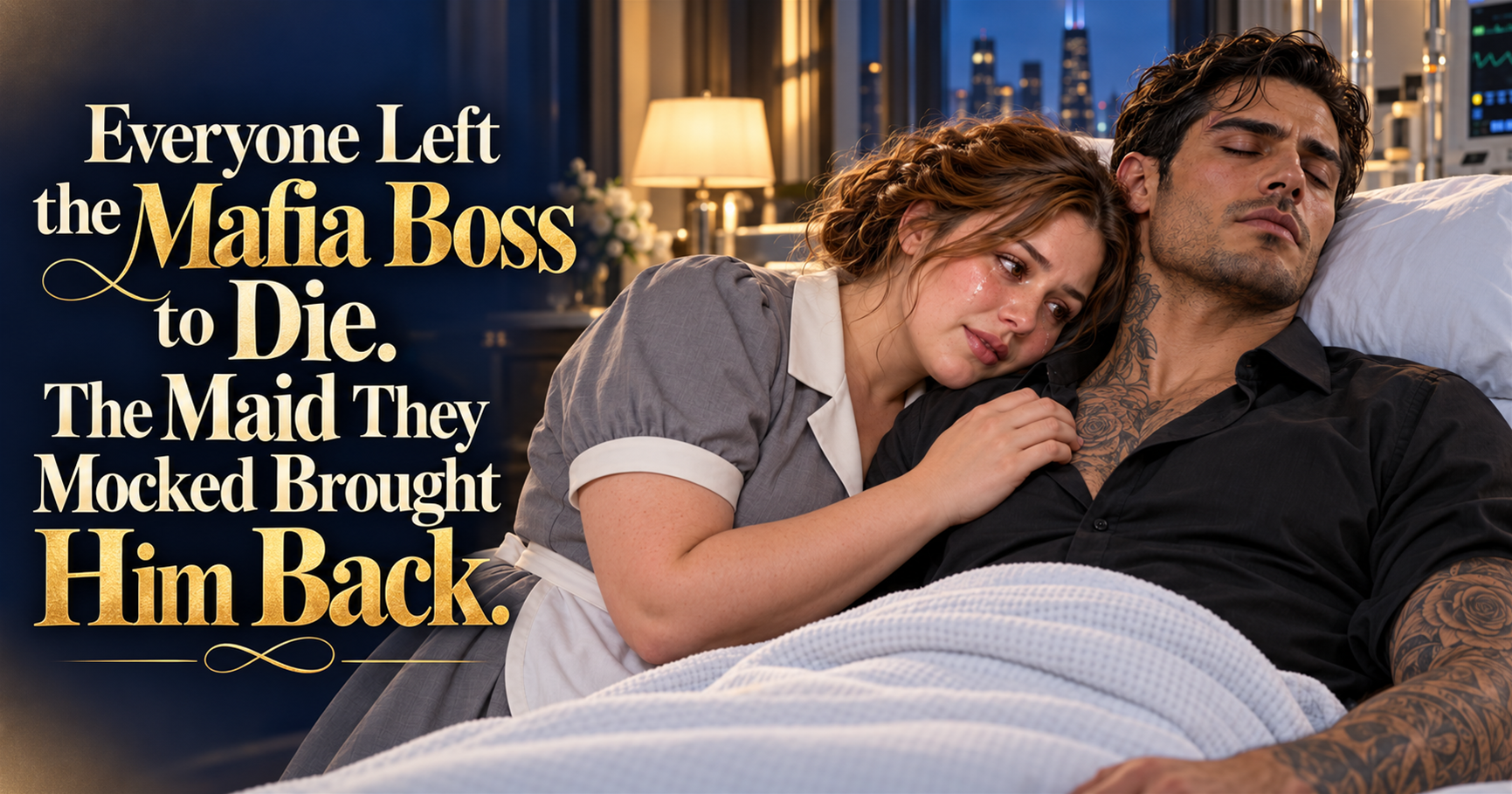
"Everyone Left the Mafia Boss to Die. The Maid They Mocked Brought Him Back." Chapter 7 — He Remembered My Name
Chapter 7 — He Remembered My Name
His hand stayed around mine long after the fire settled into embers.
Neither of us spoke.
I had expected questions. Men like Gabriel usually wanted to know what had happened, who had failed them, and what could be done about it.
Instead, he rubbed his thumb once over the back of my hand.
“Your fingers are cold.”
“They’ll warm up.”
He glanced toward my room, where the canvas bag still stood beside the door.
“Are you unpacking that?”
“Yes.”
“Good.”
I smiled despite myself.
“You make it very difficult to argue with you.”
“You seem to be managing.”
A knock came before I could answer.
Ruth entered with his evening medication. She looked at our joined hands, then at the clock.
“He needs sleep.”
“I know,” I said.
“So do you.”
Gabriel released my hand.
I stood, but before I reached the door, he called my name.
“Matilda.”
I turned.
“Thank you for staying.”
He said it without an order hidden underneath.
That made it harder to bear.
Four days later, he walked from the bed to the fireplace.
Ruth had warned him to take it slowly. He listened until she left the room, then tried to reach the chair without assistance.
I found him halfway there, one hand braced against the wall.
“Please tell me you didn’t do that just because she told you not to.”
He looked at me.
“I wanted to sit.”
“There are easier ways.”
“Yes. Apparently, all of them involve being treated like an invalid.”
“You’ve been shot. You’re allowed a few days of inconvenience.”
His jaw tightened, but he let me come close.
I offered my arm.
He looked down at it.
“I won’t break,” I said gently.
“I know.”
Then he accepted.
He was taller than I had remembered. Standing beside him felt different from watching him cross a room with half a dozen men following.
His weight settled against me carefully, as though he were trying to protect my bruised shoulder even while struggling with his own injuries.
We reached the chair.
He lowered himself with a controlled breath and closed his eyes.
I waited until the pain passed.
“Tea?”
“If you ask whether I want broth, I’m sending the kitchen staff on vacation.”
“I was going to ask whether you wanted honey.”
He opened one eye.
“Then yes.”
When I returned, he was looking at the small white scar near the base of my thumb.
“That isn’t from the cabinet.”
“No.”
“The glasses?”
I nearly dropped the saucer.
He reached to steady it.
“Careful.”
I set it on the table.
“You remember?”
“Rossi tripped you in my foyer.”
“I meant the cut.”
“You wrapped my handkerchief around it.”
I looked at him.
His expression remained calm.
“You remember that, too?”
“Yes.”
I sat in the chair opposite him.
For three months, I had carried that moment like something small and private. I assumed he had forgotten it before the blood dried.
ADVERTISEMENT
“I still have it,” I admitted.
“The handkerchief?”
“I washed it. I meant to return it.”
“Keep it.”
I looked down at my hands.
“I thought you would be angry about the glasses.”
“Why?”
“They were expensive.”
“So was the floor. I didn’t ask you to apologize to that, either.”
I laughed softly.
He watched me over the rim of his cup.
Then he said, “You rarely do that.”
“What?”
“Laugh when someone can hear you.”
The smile left my face.
I hadn’t known it was noticeable.
He put the cup down.
“Was that why you stayed?”
I understood immediately.
“The handkerchief?”
“What happened in the foyer.”
I considered lying. Saying anyone would have stayed, anyone would have climbed onto that bed.
But we both knew the house had been full.
“Yes,” I said. “Partly.”
“And the rest?”
I rubbed my thumb against my bandage.
“You always speak to me as though you expect an answer.”
His brow drew together.
“I’m not sure I understand.”
“When you ask whether the kitchen has something, you wait for me to tell you. When I’m carrying something, you move out of the way. You don’t talk over my head as if I’m furniture.”
He was silent.
“It sounds very small when I say it.”
“No.”
I swallowed.
“That night, everyone stopped seeing you as a person. They talked about your chair and your money. Nobody even asked whether you were alone.”
Gabriel’s gaze moved toward the fire.
“I’m familiar with what they wanted.”
“I know. But I wasn’t.”
He looked back at me.
“I thought loyalty meant something to them.”
“It means something until keeping it becomes inconvenient.”
I could hear the bitterness beneath his even tone.
“What happened at the warehouse?”
He shifted in the chair, then settled.
“We were meeting a buyer. Nothing unusual. Rossi had arranged the location.”
“Lorenzo said somebody opened a door.”
“Rossi did.”
I kept my eyes on his face.
“He went outside to take a call. I saw him release the loading-door lock before he left.”
“Did you know then?”
“No. One of our trucks was due. I thought he was letting it in.”
“And the men who attacked you?”
“Corsicans. They’d been trying to take a route from us for months.”
I remembered Carmine in the medical room, insisting he hadn’t known there would be shooting.
“He told you it was only about a shipment.”
“He told me what he thought might keep him alive.”
The bluntness chilled me.
Gabriel saw it.
“You don’t have to ask about this part of my life.”
“I’m not asking because I think it will sound better.”
“Then why?”
“Because I was there when you killed him.”
His face became still.
I hadn’t said it aloud before.
“I keep remembering the sound.”
“I know.”
“I don’t think you do.”
He lowered his gaze.
“You’re right.”
The admission surprised me.
ADVERTISEMENT
After a moment, he said, “I won’t ask you to pretend it didn’t happen.”
“And I won’t pretend I didn’t know what you were before.”
He looked at me for a long time.
“Does knowing make it easier?”
“No.”
I could feel my pulse in my throat.
“But I’m still here.”
His hand moved across the narrow space between our chairs.
He stopped before touching me.
I reached the rest of the way.
We sat quietly until he said, “I knew your name before the foyer.”
I blinked.
“I know. You said it in the kitchen.”
“Before that.”
“How?”
“You leave the pantry light on until the last driver comes home. You put food aside for the gardeners when they work late.”
“That’s hardly a reason to remember someone.”
“It was enough.”
I felt tears beginning and looked away.
He waited.
“You also sing when you think the service corridor is empty,” he added.
I turned back.
“I do not.”
“You do.”
“What have you heard?”
“Enough to know you forget the words halfway through.”
I covered my face with my free hand.
He laughed, carefully this time.
When I lowered my hand, he was still watching me.
Not my bandages.
Not the bruise at my wrist.
Me.
Heat rose through my chest.
“Please don’t,” I whispered.
His smile faded.
“Don’t what?”
“Look at me like that because of what happened.”
His fingers loosened immediately, giving me room to pull away.
I didn’t.
“You think I can’t tell gratitude from wanting you here?”
“I think you nearly died. I think I’m the person you remember from waking up. Those feelings might change.”
He took that seriously.
I was grateful for it.
“What would make you believe me?”
“Time.”
He nodded.
“Then time.”
“No promises you make because you’re frightened.”
“I’m not frightened of being alone in a room, Matilda.”
“Then you can let me leave one.”
A faint smile touched his mouth.
“Yes.”
I stood, taking the empty cup.
At the door, I paused.
“I’ll come back after Ruth’s visit.”
“You don’t have to.”
“I know.”
I met his eyes.
“I want to, Gabriel.”
His name felt different now.
He heard it.
And this time, when I left, he let me go without asking when I would return.
ADVERTISEMENT
You May Also Like
-
CompletedChapter 16

The Profiler's Broken Silence
Clara was the most brilliant criminal profiler in the city, gifted with the power to expose any monster with her sketches. But her world shatters when her own husband, Sebastian, betrays her to protect the man who destroyed her family. After her hands are broken and her loved ones are gone, Clara realizes that love was just a gilded cage. Now, she doesn't want his apologies—she wants his downfall.Glow-Up|Possessive Love|Second Chance|BE17.9k words5 91 -
CompletedChapter 20
Tainted Crown: A Tale of Sin and Sovereignty
Born in the freezing mud of the Lowlands, Solene learned early that survival has a price. When her mother trades their poverty for a place in Earl Dagon’s opulent mansion, Solene steps into a world of sparkling gems and deadly secrets. Behind her mask of a "Saint," she orchestrates a symphony of revenge, turning the imperial family into her puppets. The Prince, the Empire’s Golden Sun, thinks he can save her—but he is just another pawn in her cold-blooded game.Glow-Up|OE37.1k words5 54 -
CompletedChapter 13
The 999th Night: From Lovers to Strangers
After 999 nights of passion, Selina thought she was Julian's world. But to him, she was just a "placeholder" to kill time until his true love, Nina, returned. When a car crash forced him to choose, he protected Nina without a second thought, leaving Selina bleeding in the rain. Heartbroken and finally awake, Selina decides to vanish from his life forever. She books a one-way ticket across the ocean, leaving behind a decade of devotion. When Julian finally realizes that he can't live without his "shadow," all he finds is an empty house and a cold goodbye.Possessive Love|Second Chance|OE18.7k words5 43 -
CompletedChapter 12
Breaking the Ties of Love
Five years of marriage, five years of hell. Clara loved Xavier with every fiber of her being, but to him, she was nothing but a criminal—the monster who supposedly ruined his lover and crippled his sister. Locked away in a cold basement, Clara endured endless torment as penance for sins she never committed. But when the truth finally surfaces, Xavier falls to his knees, begging for a second chance. Too late. The Clara who loved him is already dead, and she is ready to walk into the darkness to escape him forever.Possessive Love|Love After Marriage|Second Chance|BE16.6k words5 41 -
CompletedChapter 12
Unloving You: A Rebirth of Letting Go
In his past life, Julian spent ten years chasing a woman who saw him only as a burden. He ruined her happiness, and in the end, she died saving him. Given a miraculous second chance, Julian wakes up on the very day of his 56th failed confession. This time, instead of flowers and pleading, he hands the bouquet to the man she truly loves. "I'm letting you go, Scarlett," he whispers. But as Julian packs his bags to disappear forever, the cold and powerful Scarlett begins to feel a suffocating panic. Why is the boy who once worshipped her now looking at her with such indifferent eyes?Glow-Up|Possessive Love|Fake Relationship|OE17.0k words5 38 -
CompletedChapter 11
After the Divorce, Hearts Came Running
Clara spent five years trapped in a cold, touchless marriage with Julian, the world-renowned surgeon who claimed he couldn't stand physical contact. But on their anniversary, after traveling thousands of miles to surprise him in Edinburgh, she found him tenderly caring for his ex-lover in the rain. At that moment, the rose in her heart finally withered. Julian chose his past; Clara chose her freedom. But when she returned home and erased every trace of him, the man who once couldn't stand her touch began to beg for a second chance.Fake Relationship|OE16.2k words5 31 -
CompletedChapter 10
The Heart He Burned
Clara Joy dedicated six years of her life and all her intellect to saving the man she loved, Julian Pierce. She immersed herself in exhaustive research to create an artificial heart that could keep him alive. However, at the moment of her greatest victory, she discovered that Julian saw her only as a pawn in a game of revenge and protection for his true lover, Vivian. He destroyed Clara's laboratory, burned her dreams, and locked her in an attic on her wedding day. But Julian forgot one thing: a broken heart cannot be mended with lies. When Clara disappears into the shadows with a mysterious stranger, Julian realizes that the heart he truly needs is not the metal one, but the one he himself threw away.Age Gap|Substitute Lover|OE12.0k words5 29 -
CompletedChapter 6
The Beast Handler's Seduction
In the depths of Sector Alpha, Dawn is the only human the bio-experiments trust. But after a laboratory glitch, the lines between caretaker and prey blur. Her subjects—a possessive Kraken, a longing Merman, and a lethal Jellyfish—have evolved. They no longer want food; they want her. As forbidden desires clash with cold steel of the lab, Dawn must decide if she is their master, or their ultimate prize.Spirits|Instant Marriage|HE5.2k words5 26 -
CompletedChapter 4
The Mafia's American Rose
After catching her boyfriend in a pathetic act of betrayal, Emily’s study abroad dream shattered. Crying on a moonlit street, she expected pity. What she got was Alessandro Romano—a man whose gaze held the quiet power of a coming storm, and whose name made the city itself hold its breath. He offered her a ride. A conversation. A glimpse into a world of opulent villas, unspoken rules, and loyalty bought with fear. He was everything she should run from: ruthless, commanding, and the undisputed head of the most powerful family in Tuscany. Yet, in his darkness, she found a shelter she never knew she needed. But in Alessandro’s world, attention is a double-edged sword. His rivals notice the American girl who dares to challenge him. His protection becomes a target on her back. When an attempted kidnapping proves the danger is all too real, Emily faces an impossible choice: flee back to her safe, ordinary life, or embrace a love that is as intoxicating as it is lethal. He has one rule: what is his, he keeps. Forever. Now, Emily must decide if she’s willing to become the most coveted prize in a war she never asked to join.Age Gap|Sweet Romance|HE5.1k words5 9