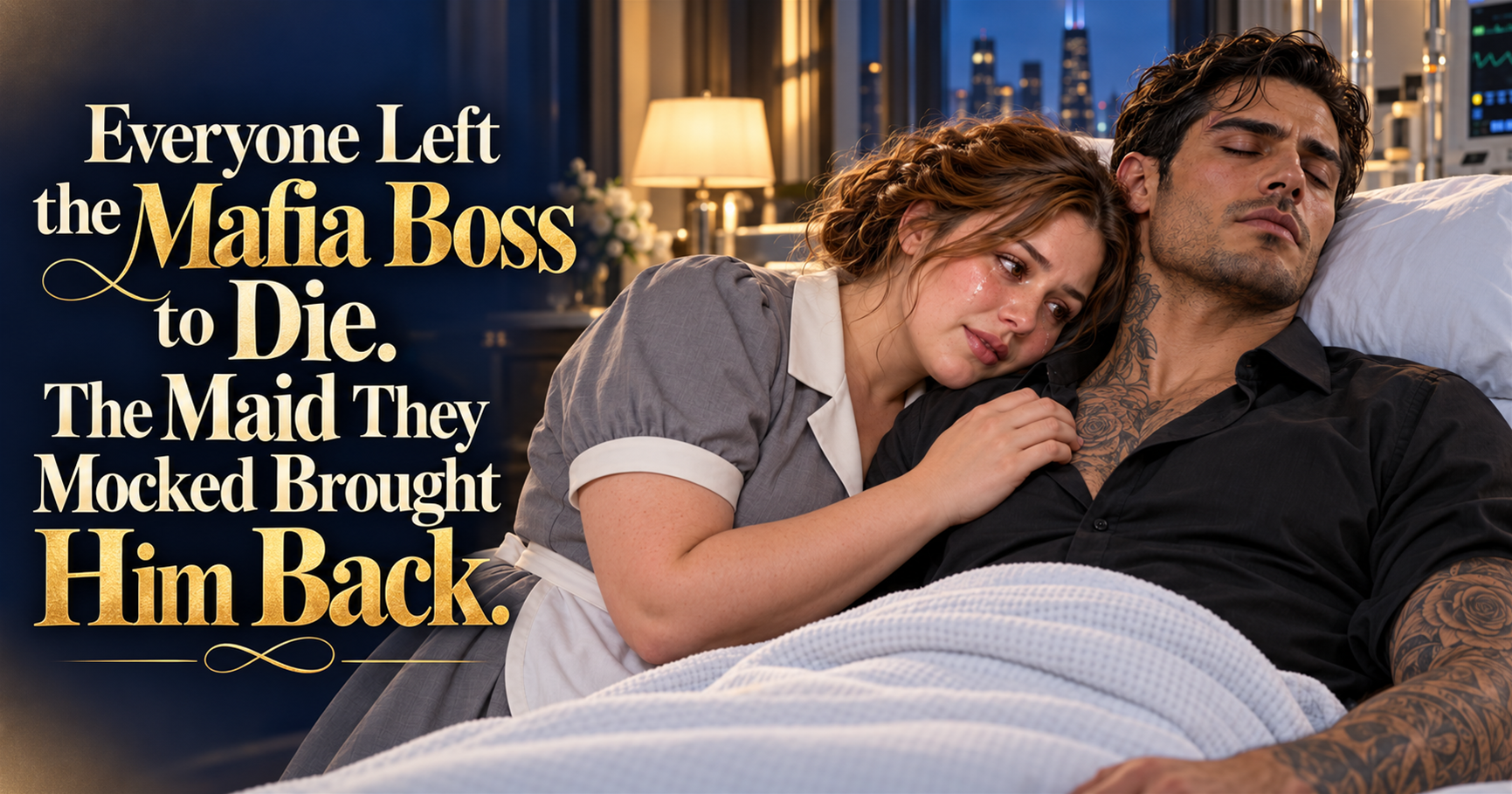
"Everyone Left the Mafia Boss to Die. The Maid They Mocked Brought Him Back." Chapter 2 — I Wouldn’t Leave Him There
Chapter 2 — I Wouldn’t Leave Him There
His eyes were closed.
That was the first thing I noticed, and for one foolish second, I thought he looked asleep.
Then I touched his cheek.
I drew my hand back.
The room was so cold that my breath caught when I inhaled. Gabriel’s skin had the stillness of stone left outdoors in winter.
“Mr. Falcone?”
I said it quietly, the way I did when he worked late and I needed to ask whether I could clear his untouched dinner.
There was no answer.
Bandages covered his abdomen and the lower edge of his chest. A dark stain had spread beneath one strip of gauze, then stopped. Someone had removed his shirt, his watch, and the gold chain I sometimes saw at his collar.
They had left him with nothing but dress trousers and a sheet.
I pulled the cloth over his foot.
“You hate the cold,” I whispered.
I knew that because he never complained about anything else in the house.
If a meal was bad, he left it. If a guest bored him, he ended the conversation. But when the terrace doors were open in winter, he shut them himself.
Last February, I had found him in the library with a blanket over his knees, speaking into a phone in a voice that made me grateful I couldn’t hear the other person.
He’d looked up when I entered.
“Please tell me there’s a reason every window in this house is open.”
“Mrs. Bell says it clears the air.”
“Mrs. Bell can clear it in July.”
I had laughed before remembering who he was.
He hadn’t seemed to mind.
Now I searched the room for a thermostat.
There was a panel beside the door. I pressed the upward arrow until the numbers changed.
The vent kept blowing.
A small line appeared beneath the temperature setting.
CENTRAL OVERRIDE.
I pressed again.
Nothing happened.
I went into the adjoining supply room and found two cotton blankets on an open shelf. I carried them back and spread them over him, careful not to disturb the bandages.
A steel tray beside the bed held scissors, bloody gauze, and a pair of gloves turned inside out.
His things sat in a clear bag.
I recognized the watch immediately.
I picked up the bag, then put it down. It felt wrong to move anything.
Voices sounded outside.
I froze with one hand still resting on the tray.
“Thought you were watching the wing.”
“Rossi wants us in the dining room.”
“What about Falcone?”
“What about him?”
The men laughed.
Their footsteps receded.
I crossed the room and turned the thumb lock.
The click seemed terribly loud.
I stood there with my hand on it, waiting for someone to come back.
Nobody did.
On the counter, a phone sat in its cradle. I lifted the receiver.
No dial tone.
ADVERTISEMENT
I pressed a button, then another. A red light blinked, but the screen remained blank.
Perhaps the system had been switched off during the lockdown. Perhaps there was a way to use it that I didn’t understand.
I replaced the receiver.
I had no phone of my own in my pocket. Staff devices stayed in our lockers during evening service. That rule had never mattered before.
Now everything I needed seemed to be on the wrong side of a door.
I returned to Gabriel.
One blanket had slipped where his shoulder met the pillow. I tucked it closer.
At the edge of the mattress, I found a lever and lowered the bed enough to sit beside him. The cushion gave beneath my weight.
“I’m sorry,” I said.
I almost smiled at the absurdity of it. Even now, I was apologizing for taking up space.
My whole life, somebody had been asking me to move.
Move so the picture looked better.
Move so a thinner girl could stand in front.
Move because the bench might break, because the aisle was narrow, because I was embarrassing someone who wanted to pretend we weren’t related.
I had become very good at folding myself inward.
Gabriel had never asked me to.
Once, in the kitchen, he had found me eating lunch alone beside the back door.
I started to stand.
“Sit,” he said.
“I’m nearly finished.”
“I came for coffee, Matilda. You don’t have to abandon your food.”
I remembered being surprised that he knew my name.
Later, I realized he knew the gardener’s name, too, and the night driver’s. He noticed more than people believed.
I looked at his hand lying beside the blanket.
There was dried blood beneath one fingernail.
I dampened a cloth with warm water from the supply room sink. It took a long time for the tap to heat. I held my own freezing fingers under it while I waited.
Then I cleaned his hand.
I worked slowly, lifting each finger, wiping away the blood without moving his arm more than necessary.
There was a faint scar across his knuckles.
Another near his wrist.
He had done terrible things with those hands. I knew that. I had heard enough conversations stop when I entered a room.
But I had also seen him hold a door for Mrs. Bell when her ankle was injured.
I had watched him tell a drunk guest to lower his voice because the kitchen staff weren’t there for entertainment.
I didn’t need him to be innocent to grieve him.
I only needed him to be gone.
A sob escaped before I could swallow it.
I pressed the cloth over my mouth.
Outside, the house continued without him.
The coffee would be cooling. Someone would complain about it. Someone would pour another whiskey and discuss what he could take.
I leaned down and rested my forehead against the edge of his shoulder.
“I don’t know what to do.”
The blankets weren’t enough. Cold air kept reaching the gaps beneath them. I could feel it against my own arms.
I took off my shoes.
For a moment, I hesitated beside the bed.
He had never invited me this close. If he could see me, he might be furious.
But he couldn’t see anything anymore.
That thought hurt worse than the cold.
I climbed onto the bed, keeping clear of his injured side, and lay beside him. There was barely room. My hip hung near the edge, and I had to brace one foot against the frame.
I pulled the blankets around both of us.
I did not put my weight across his wounds. I held his uninjured arm against me and brought my cheek close to his temple.
His hair smelled faintly of smoke and the soap from his bathroom.
“I’m here,” I said.
I kept saying it because I couldn’t bear the silence.
After a while, my breathing steadied.
My arm cramped. I shifted carefully, afraid even now of hurting him. The room’s clock made a small mechanical sound each minute.
At two-fifteen, I checked the door.
At two-thirty, I rose to wet another cloth and warm my hands.
At three, I lay beside him again.
I knew I would be dismissed if anyone found us.
I knew what they would say.
The thought came, sharp and humiliating, and for once I let it pass.
He had endured enough abandonment for one night.
I rested my palm above the edge of his bandages.
His skin seemed less cold.
I told myself that it was only the warmth from my hand. That I was desperate enough to believe anything.
Then something moved beneath my palm.
ADVERTISEMENT
You May Also Like
-
CompletedChapter 16

The Profiler's Broken Silence
Clara was the most brilliant criminal profiler in the city, gifted with the power to expose any monster with her sketches. But her world shatters when her own husband, Sebastian, betrays her to protect the man who destroyed her family. After her hands are broken and her loved ones are gone, Clara realizes that love was just a gilded cage. Now, she doesn't want his apologies—she wants his downfall.Glow-Up|Possessive Love|Second Chance|BE17.9k words5 91 -
CompletedChapter 20
Tainted Crown: A Tale of Sin and Sovereignty
Born in the freezing mud of the Lowlands, Solene learned early that survival has a price. When her mother trades their poverty for a place in Earl Dagon’s opulent mansion, Solene steps into a world of sparkling gems and deadly secrets. Behind her mask of a "Saint," she orchestrates a symphony of revenge, turning the imperial family into her puppets. The Prince, the Empire’s Golden Sun, thinks he can save her—but he is just another pawn in her cold-blooded game.Glow-Up|OE37.1k words5 54 -
CompletedChapter 13
The 999th Night: From Lovers to Strangers
After 999 nights of passion, Selina thought she was Julian's world. But to him, she was just a "placeholder" to kill time until his true love, Nina, returned. When a car crash forced him to choose, he protected Nina without a second thought, leaving Selina bleeding in the rain. Heartbroken and finally awake, Selina decides to vanish from his life forever. She books a one-way ticket across the ocean, leaving behind a decade of devotion. When Julian finally realizes that he can't live without his "shadow," all he finds is an empty house and a cold goodbye.Possessive Love|Second Chance|OE18.7k words5 43 -
CompletedChapter 12
Breaking the Ties of Love
Five years of marriage, five years of hell. Clara loved Xavier with every fiber of her being, but to him, she was nothing but a criminal—the monster who supposedly ruined his lover and crippled his sister. Locked away in a cold basement, Clara endured endless torment as penance for sins she never committed. But when the truth finally surfaces, Xavier falls to his knees, begging for a second chance. Too late. The Clara who loved him is already dead, and she is ready to walk into the darkness to escape him forever.Possessive Love|Love After Marriage|Second Chance|BE16.6k words5 41 -
CompletedChapter 12
Unloving You: A Rebirth of Letting Go
In his past life, Julian spent ten years chasing a woman who saw him only as a burden. He ruined her happiness, and in the end, she died saving him. Given a miraculous second chance, Julian wakes up on the very day of his 56th failed confession. This time, instead of flowers and pleading, he hands the bouquet to the man she truly loves. "I'm letting you go, Scarlett," he whispers. But as Julian packs his bags to disappear forever, the cold and powerful Scarlett begins to feel a suffocating panic. Why is the boy who once worshipped her now looking at her with such indifferent eyes?Glow-Up|Possessive Love|Fake Relationship|OE17.0k words5 38 -
CompletedChapter 11
After the Divorce, Hearts Came Running
Clara spent five years trapped in a cold, touchless marriage with Julian, the world-renowned surgeon who claimed he couldn't stand physical contact. But on their anniversary, after traveling thousands of miles to surprise him in Edinburgh, she found him tenderly caring for his ex-lover in the rain. At that moment, the rose in her heart finally withered. Julian chose his past; Clara chose her freedom. But when she returned home and erased every trace of him, the man who once couldn't stand her touch began to beg for a second chance.Fake Relationship|OE16.2k words5 31 -
CompletedChapter 10
The Heart He Burned
Clara Joy dedicated six years of her life and all her intellect to saving the man she loved, Julian Pierce. She immersed herself in exhaustive research to create an artificial heart that could keep him alive. However, at the moment of her greatest victory, she discovered that Julian saw her only as a pawn in a game of revenge and protection for his true lover, Vivian. He destroyed Clara's laboratory, burned her dreams, and locked her in an attic on her wedding day. But Julian forgot one thing: a broken heart cannot be mended with lies. When Clara disappears into the shadows with a mysterious stranger, Julian realizes that the heart he truly needs is not the metal one, but the one he himself threw away.Age Gap|Substitute Lover|OE12.0k words5 29 -
CompletedChapter 6
The Beast Handler's Seduction
In the depths of Sector Alpha, Dawn is the only human the bio-experiments trust. But after a laboratory glitch, the lines between caretaker and prey blur. Her subjects—a possessive Kraken, a longing Merman, and a lethal Jellyfish—have evolved. They no longer want food; they want her. As forbidden desires clash with cold steel of the lab, Dawn must decide if she is their master, or their ultimate prize.Spirits|Instant Marriage|HE5.2k words5 26 -
CompletedChapter 4
The Mafia's American Rose
After catching her boyfriend in a pathetic act of betrayal, Emily’s study abroad dream shattered. Crying on a moonlit street, she expected pity. What she got was Alessandro Romano—a man whose gaze held the quiet power of a coming storm, and whose name made the city itself hold its breath. He offered her a ride. A conversation. A glimpse into a world of opulent villas, unspoken rules, and loyalty bought with fear. He was everything she should run from: ruthless, commanding, and the undisputed head of the most powerful family in Tuscany. Yet, in his darkness, she found a shelter she never knew she needed. But in Alessandro’s world, attention is a double-edged sword. His rivals notice the American girl who dares to challenge him. His protection becomes a target on her back. When an attempted kidnapping proves the danger is all too real, Emily faces an impossible choice: flee back to her safe, ordinary life, or embrace a love that is as intoxicating as it is lethal. He has one rule: what is his, he keeps. Forever. Now, Emily must decide if she’s willing to become the most coveted prize in a war she never asked to join.Age Gap|Sweet Romance|HE5.1k words5 9