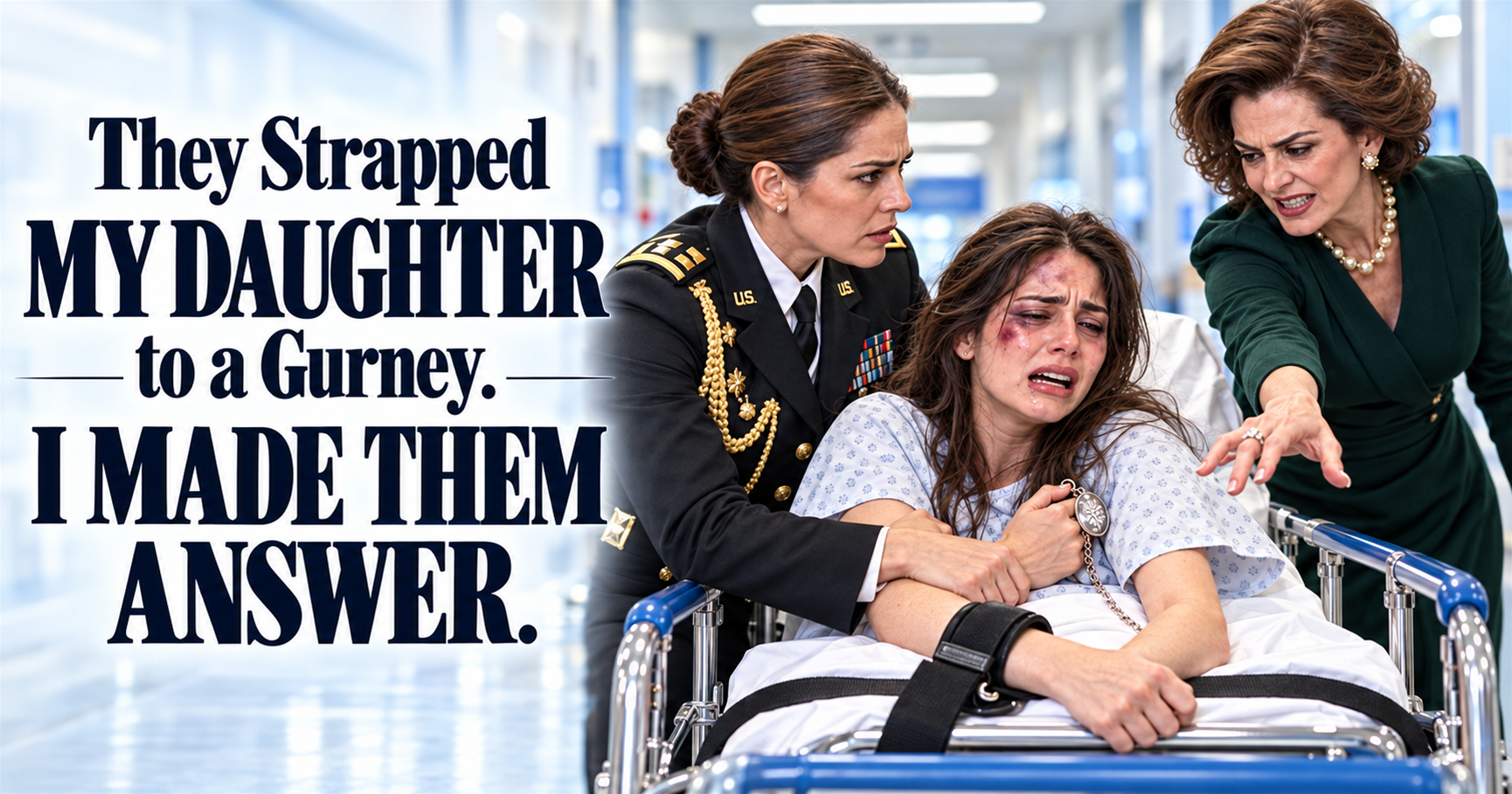
"They Strapped My Daughter to a Gurney. I Made Them Answer." Chapter 11 — Nothing Left to Hide
Chapter 11 — Nothing Left to Hide
“No,” I said.
Claire looked at the unopened bottle in her lap.
“It won’t feel that simple.”
“I know.”
I took her hand.
“You’re out of that house. Your account is in the record. You kept evidence that other people are checking. None of that disappears because a decision hurts.”
She leaned against me.
We sat until Owen came to find us.
The verdict was ready.
Julian was found guilty of assaulting her.
Claire did not cry when it was announced.
She closed her eyes.
Her hand tightened around mine, then slowly opened.
I had imagined triumph.
I had imagined watching Julian understand that he could no longer tell a room who my daughter was.
What I felt was exhaustion.
What I heard was Claire exhaling.
Outside, Owen explained the next steps. Sentencing would follow. There were still other proceedings.
Claire listened, asked two questions, and said she wanted to go home.
On the drive, she lowered the window.
Cold air moved through the car.
“Too much?” she asked.
“No.”
She left it down.
Julian received a custodial sentence. The court continued restrictions intended to keep him away from Claire.
At sentencing, he apologized.
He spoke about stress, regret, and the loss of his marriage.
Claire had prepared her own statement.
She read it without looking at him.
“I used to measure a good day by whether you were pleased with me,” she said. “I don’t do that anymore.”
She folded the page when she finished.
We left before his family could approach.
The company case took longer.
As independent records were obtained, the disputed shipments stopped being a collection of suspicious files taken by a frightened employee.
They became transactions with dates, approvals, payments, and missing equipment.
Grant’s retained records helped establish the decision trail. They also established his own participation.
He could not preserve enough material to protect himself without preserving some of what implicated him.
Vivian’s name appeared on approvals connected to transactions she had publicly described as operational matters beneath her attention.
Emails showed which concerns had reached her.
Financial records showed where money had gone.
The investigation did not confirm every suspicion Claire had raised.
Some discrepancies had ordinary explanations.
Others did not.
Claire read both kinds of findings.
“I’m glad they checked,” she told me.
Even then.
Especially then.
Grant admitted his role in the fraudulent transactions and cooperated. His sentence included prison time and repayment obligations.
Vivian eventually entered a guilty plea in the financial case after months of fighting the evidence. She received a longer prison sentence and was required to contribute to restitution.
I saw her at one of the proceedings.
She wore the same pearls she had worn in the hospital.
For years, she had made stillness look like authority.
This time, she kept adjusting the clasp of her handbag.
When she looked toward us, Claire met her eyes.
ADVERTISEMENT
Vivian looked away first.
Whitmore Medical Supply lost major contracts and came under independent oversight as it repaid affected customers and restructured.
Employees who had played no part in the scheme paid a price, too.
Claire hated that.
Owen reminded her that exposing the losses had not created them.
She understood.
It still hurt.
Kessler surrendered his medical license during the proceedings arising from his conduct. His cooperation did not erase the records he had helped create.
Briarwood changed its review procedures for disputed transfer documents and complaints from patients whose relatives were speaking for them.
Claire requested her corrected records.
She read every page.
Then she placed them in a folder and put the folder away.
The divorce was finalized on a rainy Thursday.
Owen called while we were shopping for a lamp.
Claire stood between two displays, holding a shade she had already decided was ugly.
When the call ended, she looked at me.
“It’s done.”
I took the shade from her.
“Do you want to leave?”
“No.”
She looked around.
“I still need a lamp.”
That was how we celebrated.
We bought one.
A month later, she moved into a small apartment fifteen minutes from my house.
It had uneven kitchen drawers and a balcony barely wide enough for two chairs.
She loved it.
The first evening, I helped her unpack dishes.
I reached for the cups, then stopped.
“Where do you want these?”
She pointed to a cabinet.
“Second shelf.”
I put them there.
When we finished, she handed me a key.
“For emergencies.”
I held it in my palm.
“Do grocery emergencies count?”
“Call first.”
“I’ll try to remember.”
She smiled.
“You’d better.”
She continued therapy.
She had difficult nights. Once, months after the trial, the sound of a cart rolling behind her in a medical office sent her outside shaking.
She called me.
I came.
Another time, she called to complain about a neighbor playing music.
I let her complain for twenty minutes.
I had missed ordinary calls more than I knew.
She returned to work with a small compliance organization that helped companies build better internal reporting systems.
Before accepting, she asked who reviewed concerns when senior management was involved.
She asked how records were preserved.
She asked what happened when an employee made an honest mistake while raising a legitimate problem.
The director answered.
Claire accepted the position.
She bought a plant for her desk.
Almost a year after the hospital, she brought me the locket.
The broken chain was wrapped in tissue.
“Can you fix it now?”
“Yes.”
“I don’t want the break polished out completely.”
I looked up.
“You’re sure?”
She touched the damaged link.
“I don’t need it to look like nothing happened.”
I took it to a jeweler who repaired the chain and left a small visible join.
When I gave it back, Claire opened the oval.
It was empty.
“What are you putting in it?” I asked.
“I haven’t decided.”
She fastened it around her neck anyway.
Two weeks later, we drove to the Shenandoah Valley.
The craft market had changed. The stall where I had bought her locket was gone, replaced by a woman selling pottery bowls.
We walked between tables of candles, knitted scarves, and silver jewelry.
Claire stopped at a display.
“Go look at the pottery,” she said.
“I can take a hint.”
“Then take it.”
I wandered away.
She found me ten minutes later carrying a small paper bag.
At a café, she pushed it across the table.
Inside was a silver locket with a flower engraved on the front.
I opened it.
There was a photograph of us when she was ten.
Claire had lost a front tooth. I was wearing a sweatshirt with paint on the sleeve. Her arms were wrapped around my neck, and both of us were laughing at something outside the frame.
“When did you find this?”
“In the boxes you keep promising to organize.”
“That narrows it down.”
She turned the locket over.
On the back, she had engraved three words.
Objective secured, Mom.
I pressed my thumb against the lettering.
“Am I allowed to ask about the operation?”
Claire smiled.
“The operation’s over, Mom.”
Outside, people moved between the stalls carrying purchases and paper cups. The afternoon was getting cold.
Claire stood and put on her plain winter coat.
Then she held out her hand.
“Come on. I want to see the rest before we go.”
I took it.
She led me into the market, choosing our direction without looking back to ask permission.
FIM
ADVERTISEMENT
You May Also Like
-
CompletedChapter 16

The Profiler's Broken Silence
Clara was the most brilliant criminal profiler in the city, gifted with the power to expose any monster with her sketches. But her world shatters when her own husband, Sebastian, betrays her to protect the man who destroyed her family. After her hands are broken and her loved ones are gone, Clara realizes that love was just a gilded cage. Now, she doesn't want his apologies—she wants his downfall.Glow-Up|Possessive Love|Second Chance|BE17.9k words5 91 -
CompletedChapter 20
Tainted Crown: A Tale of Sin and Sovereignty
Born in the freezing mud of the Lowlands, Solene learned early that survival has a price. When her mother trades their poverty for a place in Earl Dagon’s opulent mansion, Solene steps into a world of sparkling gems and deadly secrets. Behind her mask of a "Saint," she orchestrates a symphony of revenge, turning the imperial family into her puppets. The Prince, the Empire’s Golden Sun, thinks he can save her—but he is just another pawn in her cold-blooded game.Glow-Up|OE37.1k words5 53 -
CompletedChapter 13
The 999th Night: From Lovers to Strangers
After 999 nights of passion, Selina thought she was Julian's world. But to him, she was just a "placeholder" to kill time until his true love, Nina, returned. When a car crash forced him to choose, he protected Nina without a second thought, leaving Selina bleeding in the rain. Heartbroken and finally awake, Selina decides to vanish from his life forever. She books a one-way ticket across the ocean, leaving behind a decade of devotion. When Julian finally realizes that he can't live without his "shadow," all he finds is an empty house and a cold goodbye.Possessive Love|Second Chance|OE18.7k words5 42 -
CompletedChapter 12
Breaking the Ties of Love
Five years of marriage, five years of hell. Clara loved Xavier with every fiber of her being, but to him, she was nothing but a criminal—the monster who supposedly ruined his lover and crippled his sister. Locked away in a cold basement, Clara endured endless torment as penance for sins she never committed. But when the truth finally surfaces, Xavier falls to his knees, begging for a second chance. Too late. The Clara who loved him is already dead, and she is ready to walk into the darkness to escape him forever.Possessive Love|Love After Marriage|Second Chance|BE16.6k words5 41 -
CompletedChapter 12
Unloving You: A Rebirth of Letting Go
In his past life, Julian spent ten years chasing a woman who saw him only as a burden. He ruined her happiness, and in the end, she died saving him. Given a miraculous second chance, Julian wakes up on the very day of his 56th failed confession. This time, instead of flowers and pleading, he hands the bouquet to the man she truly loves. "I'm letting you go, Scarlett," he whispers. But as Julian packs his bags to disappear forever, the cold and powerful Scarlett begins to feel a suffocating panic. Why is the boy who once worshipped her now looking at her with such indifferent eyes?Glow-Up|Possessive Love|Fake Relationship|OE17.0k words5 38 -
CompletedChapter 11
After the Divorce, Hearts Came Running
Clara spent five years trapped in a cold, touchless marriage with Julian, the world-renowned surgeon who claimed he couldn't stand physical contact. But on their anniversary, after traveling thousands of miles to surprise him in Edinburgh, she found him tenderly caring for his ex-lover in the rain. At that moment, the rose in her heart finally withered. Julian chose his past; Clara chose her freedom. But when she returned home and erased every trace of him, the man who once couldn't stand her touch began to beg for a second chance.Fake Relationship|OE16.2k words5 31 -
CompletedChapter 10
The Heart He Burned
Clara Joy dedicated six years of her life and all her intellect to saving the man she loved, Julian Pierce. She immersed herself in exhaustive research to create an artificial heart that could keep him alive. However, at the moment of her greatest victory, she discovered that Julian saw her only as a pawn in a game of revenge and protection for his true lover, Vivian. He destroyed Clara's laboratory, burned her dreams, and locked her in an attic on her wedding day. But Julian forgot one thing: a broken heart cannot be mended with lies. When Clara disappears into the shadows with a mysterious stranger, Julian realizes that the heart he truly needs is not the metal one, but the one he himself threw away.Age Gap|Substitute Lover|OE12.0k words5 29 -
CompletedChapter 6
The Beast Handler's Seduction
In the depths of Sector Alpha, Dawn is the only human the bio-experiments trust. But after a laboratory glitch, the lines between caretaker and prey blur. Her subjects—a possessive Kraken, a longing Merman, and a lethal Jellyfish—have evolved. They no longer want food; they want her. As forbidden desires clash with cold steel of the lab, Dawn must decide if she is their master, or their ultimate prize.Spirits|Instant Marriage|HE5.2k words5 26 -
CompletedChapter 4
The Mafia's American Rose
After catching her boyfriend in a pathetic act of betrayal, Emily’s study abroad dream shattered. Crying on a moonlit street, she expected pity. What she got was Alessandro Romano—a man whose gaze held the quiet power of a coming storm, and whose name made the city itself hold its breath. He offered her a ride. A conversation. A glimpse into a world of opulent villas, unspoken rules, and loyalty bought with fear. He was everything she should run from: ruthless, commanding, and the undisputed head of the most powerful family in Tuscany. Yet, in his darkness, she found a shelter she never knew she needed. But in Alessandro’s world, attention is a double-edged sword. His rivals notice the American girl who dares to challenge him. His protection becomes a target on her back. When an attempted kidnapping proves the danger is all too real, Emily faces an impossible choice: flee back to her safe, ordinary life, or embrace a love that is as intoxicating as it is lethal. He has one rule: what is his, he keeps. Forever. Now, Emily must decide if she’s willing to become the most coveted prize in a war she never asked to join.Age Gap|Sweet Romance|HE5.1k words5 9