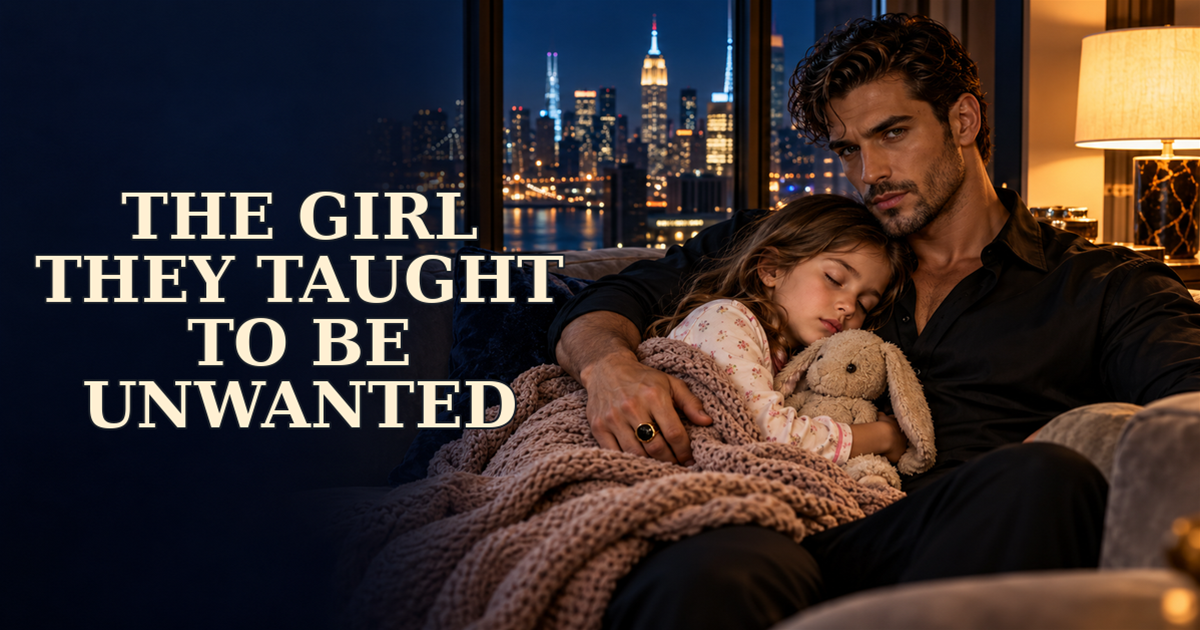
"The Girl They Taught to Be Unwanted" Chapter 11: Room for Anger
Chapter 11: Room for Anger
The investigations took longer than the first headlines did.
A local reporter heard that a wealthy logistics owner had found his niece after years apart. Grant declined an interview. Maisie was a child, not an explanation he owed the public. Tessa asked the center to keep her identifying details out of any comment it made, and Grant stopped taking calls from anyone who offered to tell the story for him.
The independent accounting identified charges to Maisie's trust for lessons never given, transportation unrelated to her care, and office expenses billed as support. The trustee sought repayment and revised its procedures so every future disbursement required documentation independent of the person requesting it. The county referred its findings about the altered child welfare records to investigators. Months later, Diane was removed from any role involving Maisie's care. A civil settlement returned the disputed funds to the trust. The separate inquiry into who submitted the false refusal continued beyond the custody decision.
Grant had wanted a single verdict that would name every wrong. Instead, different people answered different questions on different days. Maisie asked once whether Diane would be arrested. He told her he didn't know. He told her what had been confirmed and what was still being investigated.
"She was nice to me sometimes," Maisie said.
They were in the kitchen, where she was peeling a sticker from an apple.
"I believe you."
"I don't want you to tell Tessa that means she should get the money back."
"It doesn't mean that."
"I hate remembering the nice parts."
"You don't have to choose one kind of memory to tell the truth."
Maisie put the sticker on the edge of her plate. Then she ate the apple without finishing the conversation. Grant let it rest.
Permanent kinship custody came after home visits, reports from school, and another chance for Maisie to speak privately. The judge reviewed the altered placement records but did not ask Maisie to repeat what she had already told the advocate. At the end of the hearing, the judge explained that the custody order would let her stay with Grant while giving the family a path to consider adoption later.
Maisie leaned toward Tessa. "Does he get to decide my name?"
"No," Tessa said. "Your name is yours."
Grant heard the question and made a note to tell her the same thing at home. He did not want a legal document to become another adult's plan for who Maisie had to be.
That evening they ate pancakes for dinner. Maisie mixed the batter while Grant read the instructions twice and still poured too much milk. She held up the bag of flour.
"We can fix it," she said. "Maybe."
"That's a lot of confidence."
"You said first warehouses have rules. First pancakes can too."
He added flour. The pancakes came out oddly shaped and entirely edible.
ADVERTISEMENT
Life with custody was less dramatic than the hearings and more demanding. Grant missed a school concert because he wrote the wrong date in his calendar. He apologized and asked Maisie whether she wanted to show him the song at home. She refused. A week later, she played him a recording and complained that the trumpet section had been too loud.
They argued about homework. She called him unfair and slammed her bedroom door. He waited, then knocked to say dinner was ready. She came down still angry. He kept her plate warm. Neither treated the meal as an apology.
In time she began leaving the suitcase under her bed instead of beside the door. She kept snacks in the kitchen basket and sometimes took one simply because she wanted it. On her tenth birthday she invited the classmate who had finally come to meet Captain. The girl brought a new piece of fabric to repair his ear. Maisie let her help sew it.
Grant kept Anna's photograph on the hallway shelf. Some mornings Maisie stopped to tell it news before school. Other mornings she walked past without looking. Both were allowed.
When adoption became an option, Grant gave her the papers in a plain folder and told her she could ask any question before deciding. Maisie read the part about names first.
"I want to keep Reed," she said.
"Then keep Reed."
"Maybe I want Whitaker too."
"You can think about it."
She thought for several weeks. At the next appointment she told the attorney she wanted to be Maisie Reed-Whitaker. She wanted Anna's name where she could see it and Grant's beside it. When the adoption was finalized, the judge used the name Maisie had chosen.
On the drive home, she asked Grant to take the bridge from Anna's postcard. It added twenty minutes. They stopped at a public overlook and walked to the middle, where the river below looked pale under the afternoon sun.
"Mom said you thought you were always right," Maisie said.
"She had evidence."
"You still do sometimes."
"You can tell me when."
"I do."
They stayed until the wind became too cold. Grant did not try to make the bridge into a ceremony. Anna had crossed it with Maisie before he knew she existed; no visit now could give that day back. But Maisie had asked to come, and he was there.
Years later, when she left for college, she packed more than either of them believed one dorm room could hold. Captain sat on top of a box of books, his repaired ear tilted toward the car window.
At the dorm Grant carried boxes upstairs. Maisie directed him, changed her mind twice about the desk, and finally told him to stop moving the lamp. When there was nothing left to carry, he found her at the doorway with an old red paper heart.
She had made it at the family center. One side listed things she could offer a family: movie night, pancakes, a clean room. The last line said, I PROMISE TO TRY REALLY HARD.
"I found it in the flower box," she said. "I must've put it there after I moved in."
Grant remembered seeing her hide it at the adoption event. "You don't have to give it to me."
"I'm changing it first."
She drew a line through the last sentence. Beneath it she wrote, I CAN BE DIFFICULT AND STILL BELONG.
Grant read it. "You always could."
"I know now."
She put the heart in his hand. Then she took it back for a moment and added another line: YOU CAN BE WRONG AND STILL COME BACK.
"That one's for you," she said.
He folded the card carefully. "Fair."
At the door she hugged him, hard and brief. Then she let go and turned toward the unpacked boxes. Grant walked down to the car with the heart in his pocket. Upstairs, Maisie would choose where everything went. She could stay, leave, argue, return, and build a life larger than the room they'd fought so hard to keep for her.
He started the car. For once, the suitcase in the rearview mirror was empty.
ADVERTISEMENT
You May Also Like
-
CompletedChapter 16

The Profiler's Broken Silence
Clara was the most brilliant criminal profiler in the city, gifted with the power to expose any monster with her sketches. But her world shatters when her own husband, Sebastian, betrays her to protect the man who destroyed her family. After her hands are broken and her loved ones are gone, Clara realizes that love was just a gilded cage. Now, she doesn't want his apologies—she wants his downfall.Glow-Up|Possessive Love|Second Chance|BE17.9k words5 89 -
CompletedChapter 20
Tainted Crown: A Tale of Sin and Sovereignty
Born in the freezing mud of the Lowlands, Solene learned early that survival has a price. When her mother trades their poverty for a place in Earl Dagon’s opulent mansion, Solene steps into a world of sparkling gems and deadly secrets. Behind her mask of a "Saint," she orchestrates a symphony of revenge, turning the imperial family into her puppets. The Prince, the Empire’s Golden Sun, thinks he can save her—but he is just another pawn in her cold-blooded game.Glow-Up|OE37.1k words5 49 -
CompletedChapter 13
The 999th Night: From Lovers to Strangers
After 999 nights of passion, Selina thought she was Julian's world. But to him, she was just a "placeholder" to kill time until his true love, Nina, returned. When a car crash forced him to choose, he protected Nina without a second thought, leaving Selina bleeding in the rain. Heartbroken and finally awake, Selina decides to vanish from his life forever. She books a one-way ticket across the ocean, leaving behind a decade of devotion. When Julian finally realizes that he can't live without his "shadow," all he finds is an empty house and a cold goodbye.Possessive Love|Second Chance|OE18.7k words5 41 -
CompletedChapter 12
Breaking the Ties of Love
Five years of marriage, five years of hell. Clara loved Xavier with every fiber of her being, but to him, she was nothing but a criminal—the monster who supposedly ruined his lover and crippled his sister. Locked away in a cold basement, Clara endured endless torment as penance for sins she never committed. But when the truth finally surfaces, Xavier falls to his knees, begging for a second chance. Too late. The Clara who loved him is already dead, and she is ready to walk into the darkness to escape him forever.Possessive Love|Love After Marriage|Second Chance|BE16.6k words5 41 -
CompletedChapter 12
Unloving You: A Rebirth of Letting Go
In his past life, Julian spent ten years chasing a woman who saw him only as a burden. He ruined her happiness, and in the end, she died saving him. Given a miraculous second chance, Julian wakes up on the very day of his 56th failed confession. This time, instead of flowers and pleading, he hands the bouquet to the man she truly loves. "I'm letting you go, Scarlett," he whispers. But as Julian packs his bags to disappear forever, the cold and powerful Scarlett begins to feel a suffocating panic. Why is the boy who once worshipped her now looking at her with such indifferent eyes?Glow-Up|Possessive Love|Fake Relationship|OE17.0k words5 38 -
CompletedChapter 11
After the Divorce, Hearts Came Running
Clara spent five years trapped in a cold, touchless marriage with Julian, the world-renowned surgeon who claimed he couldn't stand physical contact. But on their anniversary, after traveling thousands of miles to surprise him in Edinburgh, she found him tenderly caring for his ex-lover in the rain. At that moment, the rose in her heart finally withered. Julian chose his past; Clara chose her freedom. But when she returned home and erased every trace of him, the man who once couldn't stand her touch began to beg for a second chance.Fake Relationship|OE16.2k words5 30 -
CompletedChapter 10
The Heart He Burned
Clara Joy dedicated six years of her life and all her intellect to saving the man she loved, Julian Pierce. She immersed herself in exhaustive research to create an artificial heart that could keep him alive. However, at the moment of her greatest victory, she discovered that Julian saw her only as a pawn in a game of revenge and protection for his true lover, Vivian. He destroyed Clara's laboratory, burned her dreams, and locked her in an attic on her wedding day. But Julian forgot one thing: a broken heart cannot be mended with lies. When Clara disappears into the shadows with a mysterious stranger, Julian realizes that the heart he truly needs is not the metal one, but the one he himself threw away.Age Gap|Substitute Lover|OE12.0k words5 29 -
CompletedChapter 6
The Beast Handler's Seduction
In the depths of Sector Alpha, Dawn is the only human the bio-experiments trust. But after a laboratory glitch, the lines between caretaker and prey blur. Her subjects—a possessive Kraken, a longing Merman, and a lethal Jellyfish—have evolved. They no longer want food; they want her. As forbidden desires clash with cold steel of the lab, Dawn must decide if she is their master, or their ultimate prize.Spirits|Instant Marriage|HE5.2k words5 26 -
CompletedChapter 4
The Mafia's American Rose
After catching her boyfriend in a pathetic act of betrayal, Emily’s study abroad dream shattered. Crying on a moonlit street, she expected pity. What she got was Alessandro Romano—a man whose gaze held the quiet power of a coming storm, and whose name made the city itself hold its breath. He offered her a ride. A conversation. A glimpse into a world of opulent villas, unspoken rules, and loyalty bought with fear. He was everything she should run from: ruthless, commanding, and the undisputed head of the most powerful family in Tuscany. Yet, in his darkness, she found a shelter she never knew she needed. But in Alessandro’s world, attention is a double-edged sword. His rivals notice the American girl who dares to challenge him. His protection becomes a target on her back. When an attempted kidnapping proves the danger is all too real, Emily faces an impossible choice: flee back to her safe, ordinary life, or embrace a love that is as intoxicating as it is lethal. He has one rule: what is his, he keeps. Forever. Now, Emily must decide if she’s willing to become the most coveted prize in a war she never asked to join.Age Gap|Sweet Romance|HE5.1k words5 9