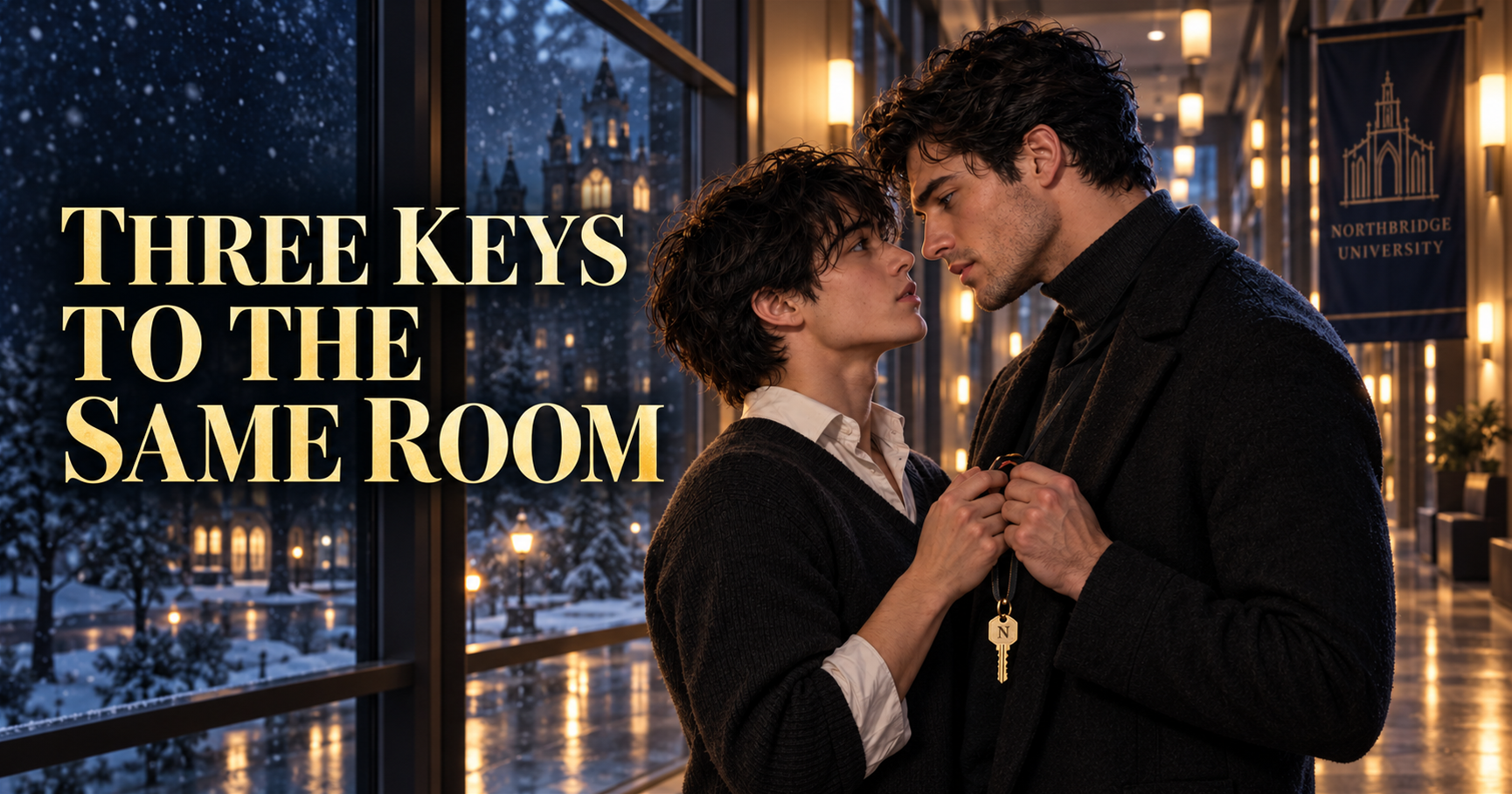
"Three Keys to the Same Room" Chapter 11: The Room We Chose
Chapter 11: The Room We Chose
I did not read my statement aloud at the conduct hearing.
I had considered it. I had imagined the clean satisfaction of making every person in that room sit through every word. But by the time the morning came, I understood that I did not owe my worst night a performance.
So I submitted the statement, answered the questions I chose to answer, and let Anika speak when the university counsel tried to turn my boundaries into a debate.
Sloane attended by video from an attorney’s office downtown. She wore a dark blazer and looked smaller on the screen than she ever had in person.
Her attorney said she disputed the meaning of the messages. He said the photos had been shared in a “competitive climate.” He said the hotel video was not intended for broad distribution.
I listened without interrupting.
When the panel asked whether I wished to respond, I did not look at Sloane. I looked at the three faculty members and the student representative who would write the decision.
"You can decide what words she meant," I said. "You have the recordings and the files. But I need you to understand the effect. I stopped sleeping. I stopped answering my phone. I started calculating whether every person who was kind to me wanted something in return. That is what it means to turn a person into leverage."
The room was silent.
"I am not asking you to fix me," I continued. "I’m asking you to make it harder for this to happen to the next person."
That was all.
The decision arrived three days later.
Sloane was found responsible under the university’s harassment, privacy, and technology-misuse policies. She was removed from student leadership, barred from the entrepreneurship competition, and suspended for the following term. The county investigation into the possible drugging continued separately. The university did not call it justice in its letter.
Neither did I.
But it called what happened a violation. It restored the words to their proper shape.
My scholarship review was closed that afternoon. Funding restored. No disciplinary notation. No conditions beyond the ordinary requirement that I keep passing classes, which suddenly felt almost luxurious.
Rowan’s independent review cleared him of plagiarism two days after that. His original drawings, time-stamped model files, and testing notes proved he had developed the accessibility work before the accusation was filed. The department asked whether he wanted to pursue a complaint against Sloane.
"Not today," he told them. "Today I want to build something."
HavenLink’s first public pilot opened in the basement of the Northbridge community center the following month.
It was smaller than the Foundation brochure had promised. There were folding tables, borrowed monitors, coffee in cardboard urns, and a sign Jace designed with too much orange. But the student volunteers from the disability resource center arrived early. So did residents from the neighborhood who had agreed to test the navigation tools.
ADVERTISEMENT
The Foundation’s grant covered equipment. The university oversight panel held the data keys. Nobody owned anybody’s story.
I stood near the entrance with a tablet and watched Rowan explain a ramp-routing feature to an older man in a red knit cap. His whole face changed when he talked about design. He became less guarded, more exact.
Miles was across the room negotiating with a local transit coordinator. He had found a paid internship, not through his father, and he looked both terrified and alive about it.
Jace appeared beside me with two paper cups of coffee.
"You know," he said, "for a project that almost died because of a blackmail campaign, this is aggressively wholesome."
"We contain multitudes."
"Mostly spreadsheets."
"Especially spreadsheets."
He bumped his shoulder against mine. "I’m glad you stayed."
The answer came easily now. "Me too."
That evening, after the volunteers left and the equipment had been boxed for the night, the four of us returned to the apartment. The same kitchen table still had a faint coffee stain from the night we had built our first evidence archive.
Miles set down a paper bag of noodles. Rowan found actual plates, which felt like evidence of personal growth. Jace announced that he had a date and disappeared before anyone could ask a follow-up question.
That left the three of us in the quiet.
I had rehearsed a speech on the walk home. It vanished the moment I looked at them.
"I need to say something," I began.
Miles leaned against the counter. Rowan sat very still.
"I don’t want either of you to decide what this is for me. I don’t want to be protected into silence or loved like I’m a reward for surviving something."
"Okay," Rowan said.
"Okay," Miles echoed.
"But I also don’t want to pretend I don’t feel anything because it’s complicated. I care about both of you. Not in the same way. Not in a way I can explain neatly. And I don’t know if I’m ready to put a label on it."
Miles’s eyes softened. "You don’t have to."
"What I am ready for is honesty," I said. "And asking. Every time."
Rowan’s gaze dropped briefly to my mouth, then returned to my eyes. "Can I kiss you?"
The question made me smile before I could stop it.
"Yes."
He crossed the kitchen slowly enough that I could have stepped away. I didn’t.
His hand settled lightly at my jaw. The kiss was warm and careful, no more dramatic than a promise that had not been written yet. When he pulled back, his forehead rested against mine for one quiet second.
Then he moved aside.
Miles did not assume. He looked at me, waiting.
"Can I?" he asked.
I reached for him first.
His kiss was different: hesitant at the beginning, then steady when I held the back of his neck. There was grief in it for everything his father had tried to turn into a debt. There was relief too.
When we separated, nobody spoke for a while.
The apartment was not magically simpler. The investigation had not erased the nights I would wake to a phone vibration that wasn’t there. Miles’s future with his family was still uncertain. Rowan still carried anger he had to choose not to weaponize. I still had papers to write and tuition bills to dread.
But the room was quiet because it was ours.
Not because someone had locked the door.
Because we had chosen to stay.
Outside the kitchen window, Northbridge glowed under the first clean snow of winter. On the table between us lay three sets of keys: mine, Rowan’s, and Miles’s.
None of them opened a cage anymore.
ADVERTISEMENT
You May Also Like
-
CompletedChapter 16

The Profiler's Broken Silence
Clara was the most brilliant criminal profiler in the city, gifted with the power to expose any monster with her sketches. But her world shatters when her own husband, Sebastian, betrays her to protect the man who destroyed her family. After her hands are broken and her loved ones are gone, Clara realizes that love was just a gilded cage. Now, she doesn't want his apologies—she wants his downfall.Glow-Up|Possessive Love|Second Chance|BE17.9k words5 89 -
CompletedChapter 20
Tainted Crown: A Tale of Sin and Sovereignty
Born in the freezing mud of the Lowlands, Solene learned early that survival has a price. When her mother trades their poverty for a place in Earl Dagon’s opulent mansion, Solene steps into a world of sparkling gems and deadly secrets. Behind her mask of a "Saint," she orchestrates a symphony of revenge, turning the imperial family into her puppets. The Prince, the Empire’s Golden Sun, thinks he can save her—but he is just another pawn in her cold-blooded game.Glow-Up|OE37.1k words5 49 -
CompletedChapter 13
The 999th Night: From Lovers to Strangers
After 999 nights of passion, Selina thought she was Julian's world. But to him, she was just a "placeholder" to kill time until his true love, Nina, returned. When a car crash forced him to choose, he protected Nina without a second thought, leaving Selina bleeding in the rain. Heartbroken and finally awake, Selina decides to vanish from his life forever. She books a one-way ticket across the ocean, leaving behind a decade of devotion. When Julian finally realizes that he can't live without his "shadow," all he finds is an empty house and a cold goodbye.Possessive Love|Second Chance|OE18.7k words5 41 -
CompletedChapter 12
Breaking the Ties of Love
Five years of marriage, five years of hell. Clara loved Xavier with every fiber of her being, but to him, she was nothing but a criminal—the monster who supposedly ruined his lover and crippled his sister. Locked away in a cold basement, Clara endured endless torment as penance for sins she never committed. But when the truth finally surfaces, Xavier falls to his knees, begging for a second chance. Too late. The Clara who loved him is already dead, and she is ready to walk into the darkness to escape him forever.Possessive Love|Love After Marriage|Second Chance|BE16.6k words5 41 -
CompletedChapter 12
Unloving You: A Rebirth of Letting Go
In his past life, Julian spent ten years chasing a woman who saw him only as a burden. He ruined her happiness, and in the end, she died saving him. Given a miraculous second chance, Julian wakes up on the very day of his 56th failed confession. This time, instead of flowers and pleading, he hands the bouquet to the man she truly loves. "I'm letting you go, Scarlett," he whispers. But as Julian packs his bags to disappear forever, the cold and powerful Scarlett begins to feel a suffocating panic. Why is the boy who once worshipped her now looking at her with such indifferent eyes?Glow-Up|Possessive Love|Fake Relationship|OE17.0k words5 38 -
CompletedChapter 11
After the Divorce, Hearts Came Running
Clara spent five years trapped in a cold, touchless marriage with Julian, the world-renowned surgeon who claimed he couldn't stand physical contact. But on their anniversary, after traveling thousands of miles to surprise him in Edinburgh, she found him tenderly caring for his ex-lover in the rain. At that moment, the rose in her heart finally withered. Julian chose his past; Clara chose her freedom. But when she returned home and erased every trace of him, the man who once couldn't stand her touch began to beg for a second chance.Fake Relationship|OE16.2k words5 30 -
CompletedChapter 10
The Heart He Burned
Clara Joy dedicated six years of her life and all her intellect to saving the man she loved, Julian Pierce. She immersed herself in exhaustive research to create an artificial heart that could keep him alive. However, at the moment of her greatest victory, she discovered that Julian saw her only as a pawn in a game of revenge and protection for his true lover, Vivian. He destroyed Clara's laboratory, burned her dreams, and locked her in an attic on her wedding day. But Julian forgot one thing: a broken heart cannot be mended with lies. When Clara disappears into the shadows with a mysterious stranger, Julian realizes that the heart he truly needs is not the metal one, but the one he himself threw away.Age Gap|Substitute Lover|OE12.0k words5 29 -
CompletedChapter 6
The Beast Handler's Seduction
In the depths of Sector Alpha, Dawn is the only human the bio-experiments trust. But after a laboratory glitch, the lines between caretaker and prey blur. Her subjects—a possessive Kraken, a longing Merman, and a lethal Jellyfish—have evolved. They no longer want food; they want her. As forbidden desires clash with cold steel of the lab, Dawn must decide if she is their master, or their ultimate prize.Spirits|Instant Marriage|HE5.2k words5 26 -
CompletedChapter 4
The Mafia's American Rose
After catching her boyfriend in a pathetic act of betrayal, Emily’s study abroad dream shattered. Crying on a moonlit street, she expected pity. What she got was Alessandro Romano—a man whose gaze held the quiet power of a coming storm, and whose name made the city itself hold its breath. He offered her a ride. A conversation. A glimpse into a world of opulent villas, unspoken rules, and loyalty bought with fear. He was everything she should run from: ruthless, commanding, and the undisputed head of the most powerful family in Tuscany. Yet, in his darkness, she found a shelter she never knew she needed. But in Alessandro’s world, attention is a double-edged sword. His rivals notice the American girl who dares to challenge him. His protection becomes a target on her back. When an attempted kidnapping proves the danger is all too real, Emily faces an impossible choice: flee back to her safe, ordinary life, or embrace a love that is as intoxicating as it is lethal. He has one rule: what is his, he keeps. Forever. Now, Emily must decide if she’s willing to become the most coveted prize in a war she never asked to join.Age Gap|Sweet Romance|HE5.1k words5 9