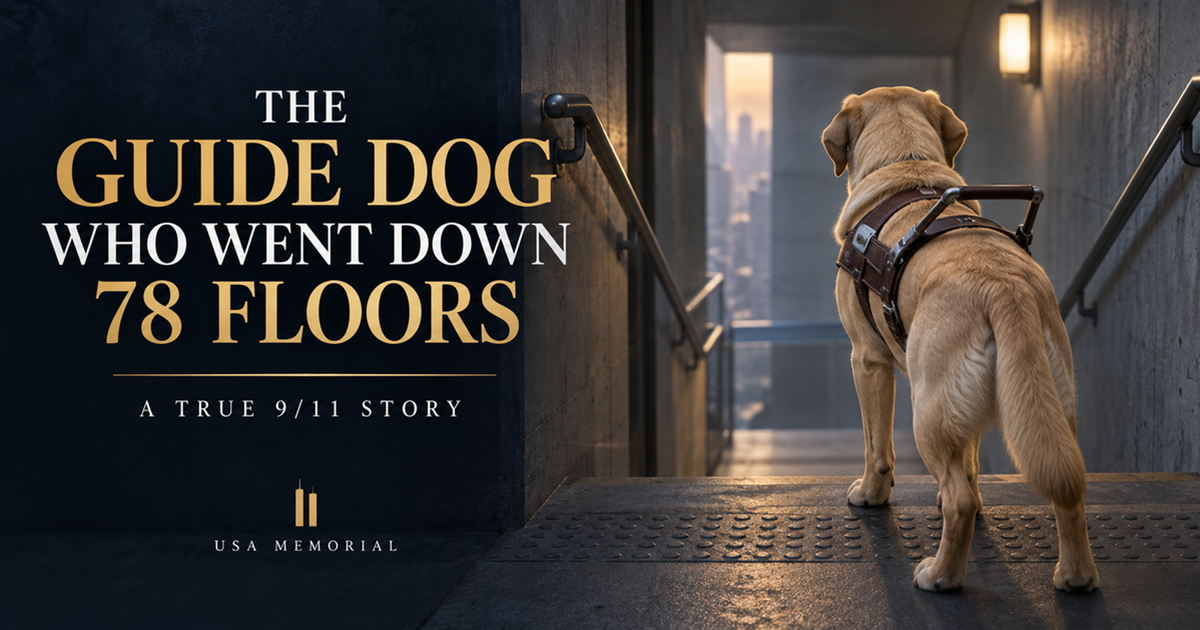
"THE GUIDE DOG WHO WENT DOWN 78 FLOORS" Chapter 1 — The Dog Beneath the Desk
Roselle was asleep when the building moved.
She lay beneath Michael Hingson’s desk on the 78th floor of the World Trade Center’s North Tower, a yellow Labrador in a guide-dog harness beside a man who had been blind since birth. It was Tuesday morning, September 11, 2001. Michael, a regional sales manager for a computer-storage company, was preparing for a business seminar with his colleague David Frank.
At 8:46 a.m., American Airlines Flight 11 struck the tower above them.
Michael heard what he later described as a muffled explosion. The building shuddered and began to lean. He and David believed for several terrible moments that the tower might continue falling toward the street. David held on to a desk. Michael stood in his office doorway. Years later, he recalled that the building seemed to move an enormous distance before slowly coming back.
Roselle woke beneath the desk.
This is where retellings often turn her into something almost supernatural: a dog who understood the attack, knew the route to safety and carried a helpless man out. Michael’s own explanation is more exact, and more remarkable. Guide dogs do not understand skyscraper emergencies in the way people do. They are trained to work in partnership. The human gives direction and makes decisions. The dog helps the team move safely around obstacles.
“The dogs don’t lead,” Michael would explain years later. “They guide.”
Roselle did not know that a hijacked airliner had torn into the tower roughly 15 floors above. Michael did not yet know it either. David could see fire and smoke outside and told him they had to leave. The three of them had different information: David had sight, Michael knew the office and the emergency procedures, and Roselle could guide through the path directly in front of them.
Michael first called his wife, Karen, at their home in New Jersey. He told her there had been an emergency. Then he and David checked the office to make sure no coworkers remained. Only after that sweep did they turn toward the stairs.
The calmness in this story did not come from an absence of danger. It came from training and habit. Michael had learned from childhood to gather information through sound, touch and movement. Roselle had learned to respond to commands, find openings and refuse a direction if it would put them in immediate danger. Their partnership depended on neither one controlling everything.
Outside their office, other workers were beginning to understand that this was not a normal alarm. The elevators could not be trusted. The journey would have to be made on foot from high above Lower Manhattan.
There was no photograph of Roselle sleeping under that desk. No camera recorded the moment she rose, entered the corridor or approached the stairwell with Michael and David. What survives is Michael’s account, repeated across interviews and preserved by institutions including the National September 11 Memorial & Museum.
The image is ordinary enough to be missed: a dog under a desk, a telephone call, a hand finding a harness. But the great test of their working life had already begun.
The location made every decision more consequential. The 78th floor was below the impact zone, which meant escape remained possible, but it was still high enough that elevators would normally define a person’s journey to the lobby. Now the elevators were removed from the plan. Distance had to be measured in flights, landings and the pace of the people ahead.
Michael did not wait for Roselle to display some mysterious knowledge. He used the evidence available. David’s description established fire and smoke above. Roselle’s composure indicated that the immediate path was not impassable. The office check established that no colleague was knowingly being left behind. Each action answered one limited question while the largest questions remained open. In hindsight, everyone knows the towers would fall. Michael, David and Roselle did not. Their choices were made without the ending.
The first question was not whether Roselle could take Michael down 78 floors.
It was whether all three of them could reach the stairwell at all.
The answer would come not in one heroic moment, but in a succession of ordinary movements performed under extraordinary pressure.
ADVERTISEMENT
You May Also Like
-
CompletedChapter 16

The Profiler's Broken Silence
Clara was the most brilliant criminal profiler in the city, gifted with the power to expose any monster with her sketches. But her world shatters when her own husband, Sebastian, betrays her to protect the man who destroyed her family. After her hands are broken and her loved ones are gone, Clara realizes that love was just a gilded cage. Now, she doesn't want his apologies—she wants his downfall.Glow-Up|Possessive Love|Second Chance|BE17.9k words5 89 -
CompletedChapter 20
Tainted Crown: A Tale of Sin and Sovereignty
Born in the freezing mud of the Lowlands, Solene learned early that survival has a price. When her mother trades their poverty for a place in Earl Dagon’s opulent mansion, Solene steps into a world of sparkling gems and deadly secrets. Behind her mask of a "Saint," she orchestrates a symphony of revenge, turning the imperial family into her puppets. The Prince, the Empire’s Golden Sun, thinks he can save her—but he is just another pawn in her cold-blooded game.Glow-Up|OE37.1k words5 49 -
CompletedChapter 13
The 999th Night: From Lovers to Strangers
After 999 nights of passion, Selina thought she was Julian's world. But to him, she was just a "placeholder" to kill time until his true love, Nina, returned. When a car crash forced him to choose, he protected Nina without a second thought, leaving Selina bleeding in the rain. Heartbroken and finally awake, Selina decides to vanish from his life forever. She books a one-way ticket across the ocean, leaving behind a decade of devotion. When Julian finally realizes that he can't live without his "shadow," all he finds is an empty house and a cold goodbye.Possessive Love|Second Chance|OE18.7k words5 41 -
CompletedChapter 12
Breaking the Ties of Love
Five years of marriage, five years of hell. Clara loved Xavier with every fiber of her being, but to him, she was nothing but a criminal—the monster who supposedly ruined his lover and crippled his sister. Locked away in a cold basement, Clara endured endless torment as penance for sins she never committed. But when the truth finally surfaces, Xavier falls to his knees, begging for a second chance. Too late. The Clara who loved him is already dead, and she is ready to walk into the darkness to escape him forever.Possessive Love|Love After Marriage|Second Chance|BE16.6k words5 41 -
CompletedChapter 12
Unloving You: A Rebirth of Letting Go
In his past life, Julian spent ten years chasing a woman who saw him only as a burden. He ruined her happiness, and in the end, she died saving him. Given a miraculous second chance, Julian wakes up on the very day of his 56th failed confession. This time, instead of flowers and pleading, he hands the bouquet to the man she truly loves. "I'm letting you go, Scarlett," he whispers. But as Julian packs his bags to disappear forever, the cold and powerful Scarlett begins to feel a suffocating panic. Why is the boy who once worshipped her now looking at her with such indifferent eyes?Glow-Up|Possessive Love|Fake Relationship|OE17.0k words5 38 -
CompletedChapter 11
After the Divorce, Hearts Came Running
Clara spent five years trapped in a cold, touchless marriage with Julian, the world-renowned surgeon who claimed he couldn't stand physical contact. But on their anniversary, after traveling thousands of miles to surprise him in Edinburgh, she found him tenderly caring for his ex-lover in the rain. At that moment, the rose in her heart finally withered. Julian chose his past; Clara chose her freedom. But when she returned home and erased every trace of him, the man who once couldn't stand her touch began to beg for a second chance.Fake Relationship|OE16.2k words5 30 -
CompletedChapter 10
The Heart He Burned
Clara Joy dedicated six years of her life and all her intellect to saving the man she loved, Julian Pierce. She immersed herself in exhaustive research to create an artificial heart that could keep him alive. However, at the moment of her greatest victory, she discovered that Julian saw her only as a pawn in a game of revenge and protection for his true lover, Vivian. He destroyed Clara's laboratory, burned her dreams, and locked her in an attic on her wedding day. But Julian forgot one thing: a broken heart cannot be mended with lies. When Clara disappears into the shadows with a mysterious stranger, Julian realizes that the heart he truly needs is not the metal one, but the one he himself threw away.Age Gap|Substitute Lover|OE12.0k words5 29 -
CompletedChapter 6
The Beast Handler's Seduction
In the depths of Sector Alpha, Dawn is the only human the bio-experiments trust. But after a laboratory glitch, the lines between caretaker and prey blur. Her subjects—a possessive Kraken, a longing Merman, and a lethal Jellyfish—have evolved. They no longer want food; they want her. As forbidden desires clash with cold steel of the lab, Dawn must decide if she is their master, or their ultimate prize.Spirits|Instant Marriage|HE5.2k words5 26 -
CompletedChapter 4
The Mafia's American Rose
After catching her boyfriend in a pathetic act of betrayal, Emily’s study abroad dream shattered. Crying on a moonlit street, she expected pity. What she got was Alessandro Romano—a man whose gaze held the quiet power of a coming storm, and whose name made the city itself hold its breath. He offered her a ride. A conversation. A glimpse into a world of opulent villas, unspoken rules, and loyalty bought with fear. He was everything she should run from: ruthless, commanding, and the undisputed head of the most powerful family in Tuscany. Yet, in his darkness, she found a shelter she never knew she needed. But in Alessandro’s world, attention is a double-edged sword. His rivals notice the American girl who dares to challenge him. His protection becomes a target on her back. When an attempted kidnapping proves the danger is all too real, Emily faces an impossible choice: flee back to her safe, ordinary life, or embrace a love that is as intoxicating as it is lethal. He has one rule: what is his, he keeps. Forever. Now, Emily must decide if she’s willing to become the most coveted prize in a war she never asked to join.Age Gap|Sweet Romance|HE5.1k words5 9