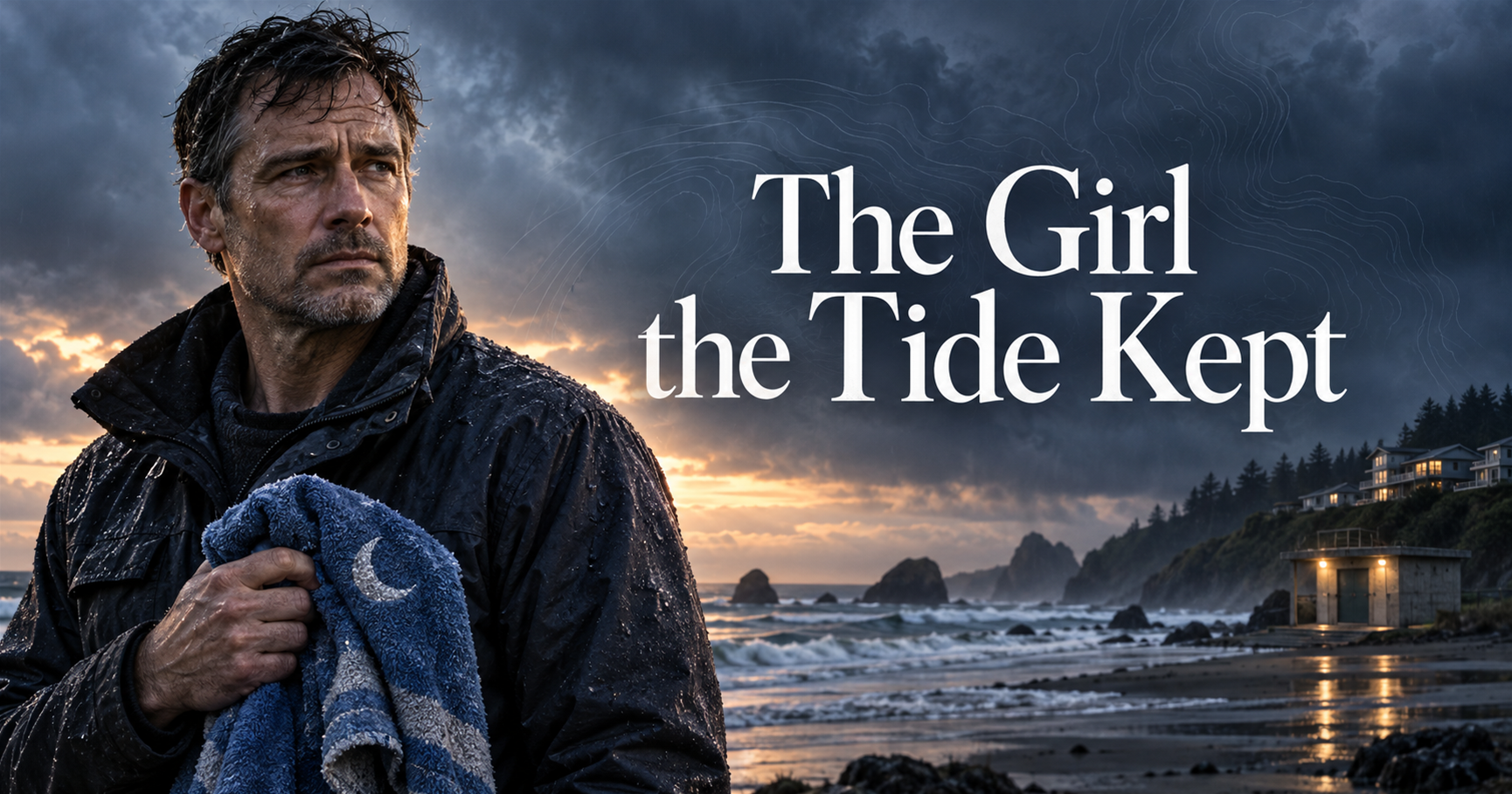
"The Girl the Tide Kept" Chapter 2: Box Twelve
Chapter 2: Box Twelve
Nora had expected anger. Families often arrived with it packed neatly under their ribs, ready for the first person in a badge who looked close enough to blame.
Eli Vale did not raise his voice.
That was worse.
“You’re telling me my parents waited thirty-eight years,” he said, “while this sat in a box?”
The interview room seemed too small for the question.
“I’m telling you it was filed as an uncorroborated juvenile statement,” Nora said. “The search that followed did not locate remains. The suspect withdrew the statement. No charges were filed.”
“Did anyone show this to my mother?”
Nora looked down at the case chronology. “Not that I can establish.”
“That means no.”
He stood and walked to the blank wall as if there might be a door there. For a moment, Nora considered saying she was sorry. But sorry was a word that made people feel handled. She had learned that early.
Instead she slid a second document toward him: a hand-drawn map in blue ink. A long road. A drainage ditch. A rectangular shape labeled OLD RACKS. A creek bending toward the sea.
“Rusk said he took officers to an abandoned oyster operation south of town,” she said. “The owner told them there had never been oyster racks, a gate, or a creek on the property. The detectives decided Rusk had invented the whole thing.”
Eli looked back at the map. “And you don’t think he did.”
“I think he knew about the towel.”
“That’s not the same thing.”
“No. It isn’t.”
He returned to the table. “What do you need from me?”
“Anything your family kept. Photographs, letters, notes from the investigation. Your mother may have recorded details that were never copied into the official file.”
His expression shuttered.
“I’m not giving you my mother’s life in a box because your department finally got curious.”
“Then don’t give it to me,” Nora said. “Look through it yourself. If you find something, decide what you want done with it.”
For the first time, she saw him hesitate.
“I’m not a witness anymore,” he said.
“No,” Nora said. “You’re not.”
He left with copies of the statement and the map tucked under his arm.
That evening, he drove to the house he had inherited two days earlier. His brothers were already there.
Ben had brought takeout no one touched. At forty-four, he still had the quick, restless way of moving he had possessed as a child, as though he expected bad news to come through a window. Lucas, youngest by a year, sat at the kitchen table with both hands around a mug of coffee.
“You met the detective,” Ben said.
Eli put the copies down.
“There was a confession.”
Lucas’s face changed before he read a word.
Ben laughed once, sharply. “A confession. Great. So all these years somebody knew.”
“Maybe,” Eli said. “It was never verified.”
ADVERTISEMENT
“It has the moon.”
Neither brother asked what he meant. They remembered the towel. They remembered their mother crying when a deputy returned it from evidence storage, cleaned and folded into a plastic bag.
Ben read the statement in silence. When he finished, he shoved it away.
“No.”
“No what?” Eli asked.
“No more detectives. No documentaries. No strangers calling Mom ‘the mother of the Tidewater girl’ like that was her whole name.”
“Mom is dead,” Eli said.
The sentence struck all three of them. Their mother had survived long enough to bury Caleb, and then, after a quiet decline no one had properly named, had gone to sleep one night and failed to wake.
“Exactly,” Ben said, softer now. “She never got an answer. We don’t need some cop making us relive it because she wants a promotion.”
“She didn’t ask for anything,” Eli said. “She found it.”
Lucas picked up the map. “What is this place?”
“Old oyster operation,” Eli said. “South of town.”
Lucas shook his head. “There isn’t one.”
“There isn’t now.”
Eli spent that night in his old room, awake beneath the sloping ceiling. At two in the morning, he went downstairs and began opening drawers.
June had kept everything. Insurance statements, school pictures, Christmas cards from people who had moved away before Mara vanished. In a cedar chest beneath spare blankets, he found a stack of newspaper clippings bound with twine. On the top was a county map with yellow marker circling Tidewater Beach and several roads leading south.
Inside the bundle was a black composition notebook.
The first pages held grocery lists and shift schedules. Then, six weeks after Mara disappeared, June’s handwriting changed. It became tighter, slanted hard to the right.
Blue truck at ferry lot. Same man watching? Asked R. at sheriff’s office. He said not to chase every shadow.
Later pages held dates, names of deputies, addresses, the words CALL AGAIN written in the margin again and again.
Near the back, Eli found an entry from March 1985.
Boy gave them a place. They say he lied because the landowner says there is no creek. But he knew the towel. How could he know the towel?
Eli sat on the floor with the notebook in his lap until daylight filled the room.
By nine, he had spread the old county map across the dining table and opened his laptop. Coastal survey work had taught him how to read the landscape as a record of things people wished had stayed buried: channels filled in for parking lots, dunes leveled for vacation homes, roads that became property lines after their original purpose was forgotten.
He pulled historical aerial imagery from a state archive and began aligning it over a modern satellite map.
The coast had changed. A marina had swallowed a mudflat. A subdivision called Seagrass Bluffs covered the land south of Tidewater. But in a black-and-white image from 1983, he found a thin creek. A line of posts. A rough access road cutting across the marsh.
And near the edge of the frame, a rectangular stain where oyster racks might once have stood.
His phone rang before he could call Nora.
“I found something,” he said when she answered.
Nora arrived an hour later with a portable scanner and a case file under one arm. She did not touch June’s notebook until Eli handed it to her.
They worked in the kitchen all afternoon, scanning pages and aligning maps. Nora asked precise questions. Eli answered only what he knew. For once, he felt less like a child being examined and more like a man who could do something useful.
“There,” he said, pointing to the 1983 photograph. “The road in Rusk’s sketch. It runs toward the creek. The property line was redrawn in 1989.”
Nora leaned close. “Can you make the scale clearer?”
“Yes.”
He adjusted the image, layer by layer. At higher resolution, the access road sharpened. So did the dark rectangle of the racks.
Nora said nothing for a long time.
Then she looked at the corner of the image, where a vehicle sat near the road, half swallowed by shadow.
“Can you enlarge that?”
Eli did.
The photograph blurred, then resolved enough to show the outline of an old panel truck: boxy body, pale roof, dark driver’s side door.
Nora opened the original file and found a witness note from the day Mara vanished.
Possible dark pickup or delivery van leaving south access road at approximately 3:20 p.m.
Eli read it twice.
“That road didn’t lead away from the beach,” he said.
“No,” Nora said. “It led to the oyster grounds.”
On the image, the truck seemed to wait at the edge of the old world, where the wetland had not yet been erased.
ADVERTISEMENT
You May Also Like
-
CompletedChapter 16

The Profiler's Broken Silence
Clara was the most brilliant criminal profiler in the city, gifted with the power to expose any monster with her sketches. But her world shatters when her own husband, Sebastian, betrays her to protect the man who destroyed her family. After her hands are broken and her loved ones are gone, Clara realizes that love was just a gilded cage. Now, she doesn't want his apologies—she wants his downfall.Glow-Up|Possessive Love|Second Chance|BE17.9k words5 89 -
CompletedChapter 20
Tainted Crown: A Tale of Sin and Sovereignty
Born in the freezing mud of the Lowlands, Solene learned early that survival has a price. When her mother trades their poverty for a place in Earl Dagon’s opulent mansion, Solene steps into a world of sparkling gems and deadly secrets. Behind her mask of a "Saint," she orchestrates a symphony of revenge, turning the imperial family into her puppets. The Prince, the Empire’s Golden Sun, thinks he can save her—but he is just another pawn in her cold-blooded game.Glow-Up|OE37.1k words5 49 -
CompletedChapter 13
The 999th Night: From Lovers to Strangers
After 999 nights of passion, Selina thought she was Julian's world. But to him, she was just a "placeholder" to kill time until his true love, Nina, returned. When a car crash forced him to choose, he protected Nina without a second thought, leaving Selina bleeding in the rain. Heartbroken and finally awake, Selina decides to vanish from his life forever. She books a one-way ticket across the ocean, leaving behind a decade of devotion. When Julian finally realizes that he can't live without his "shadow," all he finds is an empty house and a cold goodbye.Possessive Love|Second Chance|OE18.7k words5 41 -
CompletedChapter 12
Breaking the Ties of Love
Five years of marriage, five years of hell. Clara loved Xavier with every fiber of her being, but to him, she was nothing but a criminal—the monster who supposedly ruined his lover and crippled his sister. Locked away in a cold basement, Clara endured endless torment as penance for sins she never committed. But when the truth finally surfaces, Xavier falls to his knees, begging for a second chance. Too late. The Clara who loved him is already dead, and she is ready to walk into the darkness to escape him forever.Possessive Love|Love After Marriage|Second Chance|BE16.6k words5 41 -
CompletedChapter 12
Unloving You: A Rebirth of Letting Go
In his past life, Julian spent ten years chasing a woman who saw him only as a burden. He ruined her happiness, and in the end, she died saving him. Given a miraculous second chance, Julian wakes up on the very day of his 56th failed confession. This time, instead of flowers and pleading, he hands the bouquet to the man she truly loves. "I'm letting you go, Scarlett," he whispers. But as Julian packs his bags to disappear forever, the cold and powerful Scarlett begins to feel a suffocating panic. Why is the boy who once worshipped her now looking at her with such indifferent eyes?Glow-Up|Possessive Love|Fake Relationship|OE17.0k words5 38 -
CompletedChapter 11
After the Divorce, Hearts Came Running
Clara spent five years trapped in a cold, touchless marriage with Julian, the world-renowned surgeon who claimed he couldn't stand physical contact. But on their anniversary, after traveling thousands of miles to surprise him in Edinburgh, she found him tenderly caring for his ex-lover in the rain. At that moment, the rose in her heart finally withered. Julian chose his past; Clara chose her freedom. But when she returned home and erased every trace of him, the man who once couldn't stand her touch began to beg for a second chance.Fake Relationship|OE16.2k words5 30 -
CompletedChapter 10
The Heart He Burned
Clara Joy dedicated six years of her life and all her intellect to saving the man she loved, Julian Pierce. She immersed herself in exhaustive research to create an artificial heart that could keep him alive. However, at the moment of her greatest victory, she discovered that Julian saw her only as a pawn in a game of revenge and protection for his true lover, Vivian. He destroyed Clara's laboratory, burned her dreams, and locked her in an attic on her wedding day. But Julian forgot one thing: a broken heart cannot be mended with lies. When Clara disappears into the shadows with a mysterious stranger, Julian realizes that the heart he truly needs is not the metal one, but the one he himself threw away.Age Gap|Substitute Lover|OE12.0k words5 29 -
CompletedChapter 6
The Beast Handler's Seduction
In the depths of Sector Alpha, Dawn is the only human the bio-experiments trust. But after a laboratory glitch, the lines between caretaker and prey blur. Her subjects—a possessive Kraken, a longing Merman, and a lethal Jellyfish—have evolved. They no longer want food; they want her. As forbidden desires clash with cold steel of the lab, Dawn must decide if she is their master, or their ultimate prize.Spirits|Instant Marriage|HE5.2k words5 26 -
CompletedChapter 4
The Mafia's American Rose
After catching her boyfriend in a pathetic act of betrayal, Emily’s study abroad dream shattered. Crying on a moonlit street, she expected pity. What she got was Alessandro Romano—a man whose gaze held the quiet power of a coming storm, and whose name made the city itself hold its breath. He offered her a ride. A conversation. A glimpse into a world of opulent villas, unspoken rules, and loyalty bought with fear. He was everything she should run from: ruthless, commanding, and the undisputed head of the most powerful family in Tuscany. Yet, in his darkness, she found a shelter she never knew she needed. But in Alessandro’s world, attention is a double-edged sword. His rivals notice the American girl who dares to challenge him. His protection becomes a target on her back. When an attempted kidnapping proves the danger is all too real, Emily faces an impossible choice: flee back to her safe, ordinary life, or embrace a love that is as intoxicating as it is lethal. He has one rule: what is his, he keeps. Forever. Now, Emily must decide if she’s willing to become the most coveted prize in a war she never asked to join.Age Gap|Sweet Romance|HE5.1k words5 9