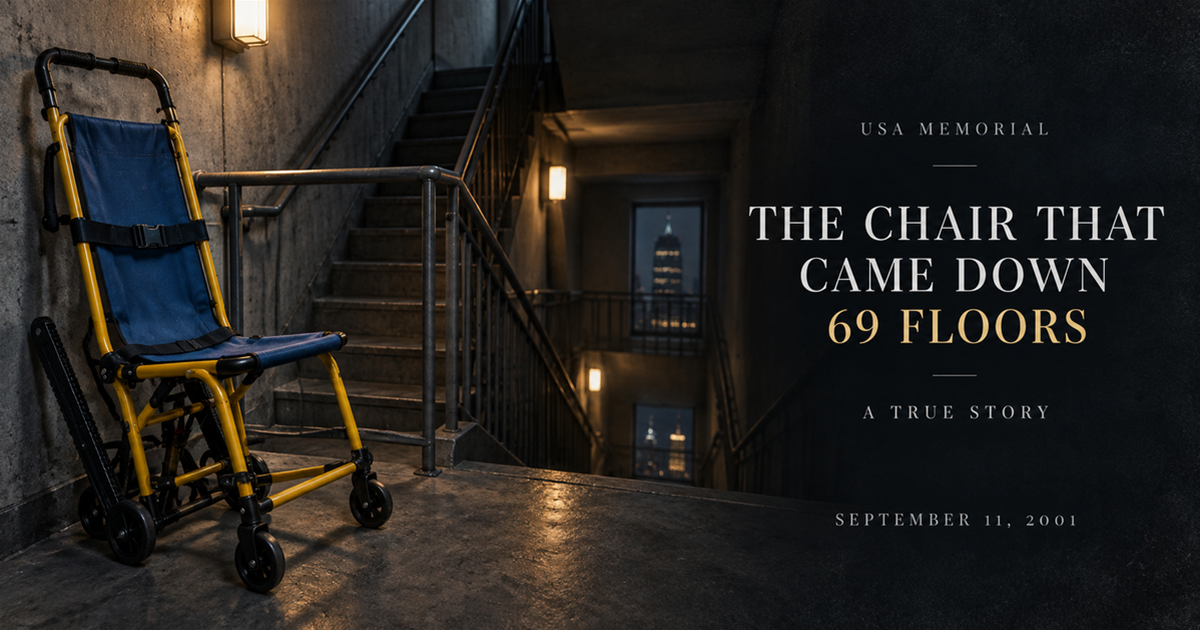
"THE CHAIR THAT CAME DOWN 69 FLOORS" Chapter 9 — The Chair He Took Home
After September 11, the blue and yellow evacuation chair was no longer ordinary workplace equipment.
Its value no longer came from its purchase price or manufacturer’s specifications. Its value came from provenance: who used it, where it traveled, and which documented event it survived.
John Abruzzo took it home.
The chair had carried him farther than its appearance suggested possible. It had descended 69 floors, crossed a damaged lobby, passed through a broken window, traveled through Lower Manhattan, and entered Stuyvesant High School ahead of the collapse cloud.
It was also credited by the 9/11 Memorial with helping five other people escape the World Trade Center that day.
The Museum’s records identify the object as an anonymous gift in one account and as a gift of Mike Fabiano in a later presentation. The difference concerns the public credit line, not the chair’s documented role in Abruzzo’s evacuation. The later Memorial article explicitly identifies it as the chair that carried him to safety.
In 2008, the chair entered the collection of the National September 11 Memorial & Museum.
The accession changed its public function. It was no longer only a survivor’s possession. It became material evidence available to support a documented history of disability, emergency planning, workplace loyalty, and escape from the North Tower.
By then, the site where the towers had stood was being transformed into a place of remembrance and public history. The Museum’s future collection was gathering objects large and small: damaged emergency vehicles, identification cards, clothing, tools, photographs, recordings, and personal possessions.
The evacuation chair belonged among them because it explained a part of the disaster that photographs of the skyline could not.
It told the story of movement inside the building.
It showed how disability changed the meaning of a staircase.
It preserved evidence that preparation after 1993 had mattered.
It also carried the trace of ten coworkers whose actions were not recorded by a camera as they happened.
That absence is typical of many human stories inside the towers. The most consequential acts occurred in stairwells, offices, and corridors where no journalist stood ready. Later testimony and surviving objects are therefore essential, but they must be handled without inventing what they cannot show.
There is no known photograph of the group halfway down the stairwell. No video follows them around the landings. Their descent survives through first-person accounts, early reporting, oral history, and the object itself.
That makes the chair especially important.
It cannot reproduce every moment. It cannot tell visitors how heavy it felt on the 40th floor or how the handlers’ arms ached near the bottom. It cannot reveal the exact tone of every exchange.
But it establishes that the device existed, that it was used, and that it survived.
The Museum photographed it against a plain white background. In that image, the chair is separated from smoke, stairs, and noise. Its construction becomes easy to study: blue tubing, yellow supports, black tracks, straps, handles, and small wheels.
The photograph’s clean background should not be mistaken for permission to use it commercially. The Museum identifies its photographer and maintains copyright over its site. Authenticity and usage rights remain separate questions even when the object is unquestionably genuine.
Another documented photograph shows Abruzzo beside the chair after the attacks. Newsday photographer J. Conrad Williams Jr. made that image in 2001. It places the survivor and the object together, but its commercial rights remain with the news organization.
Neither photograph should be confused with an image of the rescue itself.
No authentic photograph is known to show Abruzzo being carried down the North Tower stairs.
That absence matters. It prevents later storytellers from turning reenactments into false evidence.
The real chair does not need a fabricated scene to make its point.
It sits in the Museum because a safety device became a lifeline, because ten people refused to walk away, and because 69 floors separated a man from the street.
Its final location closes a circle.
The chair returned to the place where it had been needed.
It returned not as equipment waiting for another alarm, but as evidence of what preparation and loyalty had accomplished during one.
This time, no one was asking it to move.
The object that once existed for a future emergency had become a warning from the past: evacuation plans matter most when they account for people who cannot follow the standard route alone.
ADVERTISEMENT
You May Also Like
-
CompletedChapter 16

The Profiler's Broken Silence
Clara was the most brilliant criminal profiler in the city, gifted with the power to expose any monster with her sketches. But her world shatters when her own husband, Sebastian, betrays her to protect the man who destroyed her family. After her hands are broken and her loved ones are gone, Clara realizes that love was just a gilded cage. Now, she doesn't want his apologies—she wants his downfall.Glow-Up|Possessive Love|Second Chance|BE17.9k words5 89 -
CompletedChapter 20
Tainted Crown: A Tale of Sin and Sovereignty
Born in the freezing mud of the Lowlands, Solene learned early that survival has a price. When her mother trades their poverty for a place in Earl Dagon’s opulent mansion, Solene steps into a world of sparkling gems and deadly secrets. Behind her mask of a "Saint," she orchestrates a symphony of revenge, turning the imperial family into her puppets. The Prince, the Empire’s Golden Sun, thinks he can save her—but he is just another pawn in her cold-blooded game.Glow-Up|OE37.1k words5 49 -
CompletedChapter 13
The 999th Night: From Lovers to Strangers
After 999 nights of passion, Selina thought she was Julian's world. But to him, she was just a "placeholder" to kill time until his true love, Nina, returned. When a car crash forced him to choose, he protected Nina without a second thought, leaving Selina bleeding in the rain. Heartbroken and finally awake, Selina decides to vanish from his life forever. She books a one-way ticket across the ocean, leaving behind a decade of devotion. When Julian finally realizes that he can't live without his "shadow," all he finds is an empty house and a cold goodbye.Possessive Love|Second Chance|OE18.7k words5 41 -
CompletedChapter 12
Breaking the Ties of Love
Five years of marriage, five years of hell. Clara loved Xavier with every fiber of her being, but to him, she was nothing but a criminal—the monster who supposedly ruined his lover and crippled his sister. Locked away in a cold basement, Clara endured endless torment as penance for sins she never committed. But when the truth finally surfaces, Xavier falls to his knees, begging for a second chance. Too late. The Clara who loved him is already dead, and she is ready to walk into the darkness to escape him forever.Possessive Love|Love After Marriage|Second Chance|BE16.6k words5 41 -
CompletedChapter 12
Unloving You: A Rebirth of Letting Go
In his past life, Julian spent ten years chasing a woman who saw him only as a burden. He ruined her happiness, and in the end, she died saving him. Given a miraculous second chance, Julian wakes up on the very day of his 56th failed confession. This time, instead of flowers and pleading, he hands the bouquet to the man she truly loves. "I'm letting you go, Scarlett," he whispers. But as Julian packs his bags to disappear forever, the cold and powerful Scarlett begins to feel a suffocating panic. Why is the boy who once worshipped her now looking at her with such indifferent eyes?Glow-Up|Possessive Love|Fake Relationship|OE17.0k words5 38 -
CompletedChapter 11
After the Divorce, Hearts Came Running
Clara spent five years trapped in a cold, touchless marriage with Julian, the world-renowned surgeon who claimed he couldn't stand physical contact. But on their anniversary, after traveling thousands of miles to surprise him in Edinburgh, she found him tenderly caring for his ex-lover in the rain. At that moment, the rose in her heart finally withered. Julian chose his past; Clara chose her freedom. But when she returned home and erased every trace of him, the man who once couldn't stand her touch began to beg for a second chance.Fake Relationship|OE16.2k words5 30 -
CompletedChapter 10
The Heart He Burned
Clara Joy dedicated six years of her life and all her intellect to saving the man she loved, Julian Pierce. She immersed herself in exhaustive research to create an artificial heart that could keep him alive. However, at the moment of her greatest victory, she discovered that Julian saw her only as a pawn in a game of revenge and protection for his true lover, Vivian. He destroyed Clara's laboratory, burned her dreams, and locked her in an attic on her wedding day. But Julian forgot one thing: a broken heart cannot be mended with lies. When Clara disappears into the shadows with a mysterious stranger, Julian realizes that the heart he truly needs is not the metal one, but the one he himself threw away.Age Gap|Substitute Lover|OE12.0k words5 29 -
CompletedChapter 6
The Beast Handler's Seduction
In the depths of Sector Alpha, Dawn is the only human the bio-experiments trust. But after a laboratory glitch, the lines between caretaker and prey blur. Her subjects—a possessive Kraken, a longing Merman, and a lethal Jellyfish—have evolved. They no longer want food; they want her. As forbidden desires clash with cold steel of the lab, Dawn must decide if she is their master, or their ultimate prize.Spirits|Instant Marriage|HE5.2k words5 26 -
CompletedChapter 4
The Mafia's American Rose
After catching her boyfriend in a pathetic act of betrayal, Emily’s study abroad dream shattered. Crying on a moonlit street, she expected pity. What she got was Alessandro Romano—a man whose gaze held the quiet power of a coming storm, and whose name made the city itself hold its breath. He offered her a ride. A conversation. A glimpse into a world of opulent villas, unspoken rules, and loyalty bought with fear. He was everything she should run from: ruthless, commanding, and the undisputed head of the most powerful family in Tuscany. Yet, in his darkness, she found a shelter she never knew she needed. But in Alessandro’s world, attention is a double-edged sword. His rivals notice the American girl who dares to challenge him. His protection becomes a target on her back. When an attempted kidnapping proves the danger is all too real, Emily faces an impossible choice: flee back to her safe, ordinary life, or embrace a love that is as intoxicating as it is lethal. He has one rule: what is his, he keeps. Forever. Now, Emily must decide if she’s willing to become the most coveted prize in a war she never asked to join.Age Gap|Sweet Romance|HE5.1k words5 9