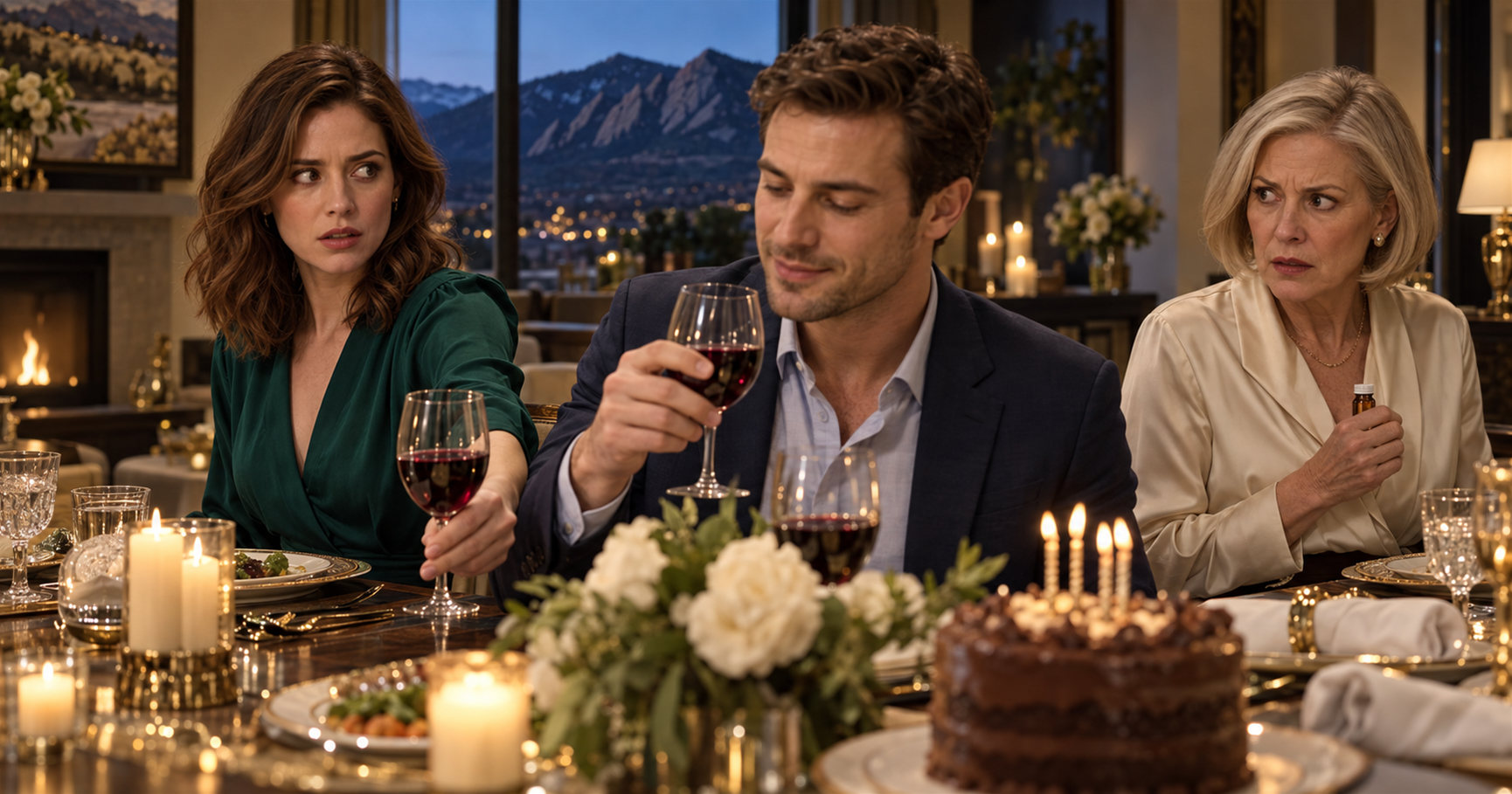
"My mother-in-law put something in my drink during a family dinner; I swapped glasses with my husband." Chapter 1 The Special Glass
Chapter 1
The Special Glass
I saw my mother-in-law tip a small glass vial over my drink when she thought I was looking for dessert plates.
The liquid vanished into the pale gold wine without changing its color. Diane Caldwell slipped the vial into the pocket of her silk blouse, turned, and smiled at me.
“There you are, Claire. I made this one especially for you.”
She lifted the glass by the stem. Her hand was steady, but her smile was too wide.
Two minutes earlier, I had been tired enough to ignore almost anything.
I had spent four days above eleven thousand feet photographing a bighorn ewe and her lamb for a Rocky Mountain wildlife feature. Wind had split the skin across my knuckles. I had slept six hours in two nights. My first solo gallery show in Denver opened on Sunday, and I still had twelve prints to inspect.
But it was Diane’s sixtieth birthday, and my husband had asked me to come.
“Just dinner,” Ethan had promised as we drove toward his parents’ house in Boulder. “We’ll leave before nine.”
We both knew his family never let anything be just dinner.
Richard had started before the salad.
“So,” my father-in-law said, cutting into an heirloom tomato, “is the mountain adventure paying actual money, or is this one for exposure?”
“The magazine pays,” I said.
“Enough to cover the equipment?”
Ethan put down his fork. “Dad.”
Richard raised one shoulder. “I’m interested. Photography is an expensive hobby.”
“It’s her career,” Ethan said.
Diane touched her son’s wrist as if calming an agitated child. “Your father only worries. Consulting has benefits, retirement matching, predictable hours. Creative work can be so unstable.”
Across the table, Ethan’s sister, Natalie, stared at her plate. Her husband, Owen, gave me a brief look that said he had heard his own version of this speech.
I had been married to Ethan for three years. I had spent all three bringing expensive wine to the Caldwells’ house, remembering birthdays, praising Diane’s centerpieces, and swallowing every sentence that ended with the suggestion that Ethan had married beneath him.
That night, I had brought a framed photograph of dawn breaking over Longs Peak. Diane thanked me and set it behind two unopened gifts.
After the main course, she announced that she had made her famous chocolate torte. Everyone applauded as if she had cured something.
I offered to help.
In the kitchen, six dessert glasses stood on a silver tray. Five were clustered together. The sixth sat near the sink beside Diane’s purse.
Then she took out the vial.
Now she stood between me and the tray, holding that separate glass toward me.
“What’s in it?” I asked.
“White wine, elderflower, and a little family secret.” Her eyes stayed on mine. “For my favorite daughter-in-law.”
I was her only daughter-in-law.
“You didn’t have to go to any trouble.”
ADVERTISEMENT
“It was no trouble at all.” She moved the glass closer. “Try it.”
There are moments when fear arrives loudly. A slammed door. Tires skidding. A branch cracking behind you in the dark.
This fear was quiet.
It was a clear film on the surface of a drink. It was the memory of Diane asking, three times that week, whether my gallery opening could be postponed. It was the way she had smiled when I told her a curator from New York might attend.
I took the glass.
“Perfect,” she said.
“Let me carry the tray.”
Her fingers tightened on its handles. “I’ve got it.”
“And risk the birthday girl spilling dessert?” I smiled and lifted the other end before she could object. “Never.”
We carried the tray into the dining room together.
Ethan sat to my right. Richard sat at the head of the table, checking an email. Diane began passing out plates, which gave me four seconds when every eye was elsewhere.
I set my glass beside Ethan’s water. Then I asked Richard about the building his firm had just bought downtown.
He launched into an answer.
While Diane turned to cut the torte, I switched my glass with Ethan’s untouched wine.
I told myself he would take one sip. I told myself that if the drink tasted wrong, he would stop. More shamefully, I told myself Diane would never put anything truly dangerous into a glass meant for me.
I needed to know whether I had seen what I thought I had seen.
Ethan lifted the wine.
My pulse struck hard against my throat.
“Wait,” I said.
He paused with the rim near his mouth. “What?”
Diane looked at me.
The challenge in her expression lasted less than a second, but I saw it.
I picked up Ethan’s original glass—the one now in front of me—and forced a laugh. “Nothing. I thought this was yours.”
He took a long drink.
Diane’s face emptied.
For the next twenty minutes, nothing happened.
Richard talked about the market. Diane pushed torte onto everyone. Natalie asked about my show, and I described the largest print, a cow elk standing in smoke after a controlled burn.
Ethan squeezed my knee under the table.
“You okay?” he murmured.
“Just tired.”
I hated how normal he sounded.
At thirty minutes, he rubbed both eyes.
At thirty-five, he dropped his fork.
At forty, his words began sticking together.
“I think I need air.” He pushed back his chair and nearly fell.
I caught his arm. His full weight collapsed against me.
“Ethan?”
His pupils looked wrong. His face had gone slack, and sweat shone along his hairline.
Diane rushed around the table. “He’s exhausted. Richard, help him upstairs.”
“No.” I pulled out my phone. “I’m calling 911.”
Her hand closed over my wrist.
“Don’t be dramatic. He had wine on an empty stomach.”
“He ate three courses.”
“Claire,” Richard snapped. “Put the phone down.”
Ethan tried to say my name. It came out as air.
I made the call.
While Richard lowered him to the rug, Diane disappeared into the dining room. China clattered. Water rushed in the kitchen sink.
She was clearing the table.
I opened my camera and photographed both wine glasses where they stood, the half-eaten dessert, and the wet ring left beside Ethan’s plate. Then I pulled a clean food-storage bag from a drawer, wrapped my hand in a dish towel, and sealed the glass he had used inside it.
Diane came through the doorway and stopped.
“Give me that,” she said.
“No.”
For once, she did not pretend to misunderstand me.
The paramedics arrived six minutes later. I rode with Ethan to the hospital, the sealed glass inside my camera bag and Diane’s stare following me all the way to the ambulance doors.
Near midnight, a doctor found me outside the treatment room.
“Your husband is stable,” she said. “But what we’re seeing is not consistent with two glasses of wine.”
Relief almost folded me in half.
Then I heard heels clicking down the corridor.
Diane stopped beside me. Richard stood behind her, grim and silent.
She waited until the doctor walked away. Then she leaned close enough for me to smell her perfume.
“What exactly did you do with that glass?” she whispered.
ADVERTISEMENT
You May Also Like
-
CompletedChapter 16

The Profiler's Broken Silence
Clara was the most brilliant criminal profiler in the city, gifted with the power to expose any monster with her sketches. But her world shatters when her own husband, Sebastian, betrays her to protect the man who destroyed her family. After her hands are broken and her loved ones are gone, Clara realizes that love was just a gilded cage. Now, she doesn't want his apologies—she wants his downfall.Glow-Up|Possessive Love|Second Chance|BE17.9k words5 84 -
CompletedChapter 20
Tainted Crown: A Tale of Sin and Sovereignty
Born in the freezing mud of the Lowlands, Solene learned early that survival has a price. When her mother trades their poverty for a place in Earl Dagon’s opulent mansion, Solene steps into a world of sparkling gems and deadly secrets. Behind her mask of a "Saint," she orchestrates a symphony of revenge, turning the imperial family into her puppets. The Prince, the Empire’s Golden Sun, thinks he can save her—but he is just another pawn in her cold-blooded game.Glow-Up|OE37.1k words5 43 -
CompletedChapter 12
Breaking the Ties of Love
Five years of marriage, five years of hell. Clara loved Xavier with every fiber of her being, but to him, she was nothing but a criminal—the monster who supposedly ruined his lover and crippled his sister. Locked away in a cold basement, Clara endured endless torment as penance for sins she never committed. But when the truth finally surfaces, Xavier falls to his knees, begging for a second chance. Too late. The Clara who loved him is already dead, and she is ready to walk into the darkness to escape him forever.Possessive Love|Love After Marriage|Second Chance|BE16.6k words5 41 -
CompletedChapter 13
The 999th Night: From Lovers to Strangers
After 999 nights of passion, Selina thought she was Julian's world. But to him, she was just a "placeholder" to kill time until his true love, Nina, returned. When a car crash forced him to choose, he protected Nina without a second thought, leaving Selina bleeding in the rain. Heartbroken and finally awake, Selina decides to vanish from his life forever. She books a one-way ticket across the ocean, leaving behind a decade of devotion. When Julian finally realizes that he can't live without his "shadow," all he finds is an empty house and a cold goodbye.Possessive Love|Second Chance|OE18.7k words5 40 -
CompletedChapter 12
Unloving You: A Rebirth of Letting Go
In his past life, Julian spent ten years chasing a woman who saw him only as a burden. He ruined her happiness, and in the end, she died saving him. Given a miraculous second chance, Julian wakes up on the very day of his 56th failed confession. This time, instead of flowers and pleading, he hands the bouquet to the man she truly loves. "I'm letting you go, Scarlett," he whispers. But as Julian packs his bags to disappear forever, the cold and powerful Scarlett begins to feel a suffocating panic. Why is the boy who once worshipped her now looking at her with such indifferent eyes?Glow-Up|Possessive Love|Fake Relationship|OE17.0k words5 38 -
CompletedChapter 11
After the Divorce, Hearts Came Running
Clara spent five years trapped in a cold, touchless marriage with Julian, the world-renowned surgeon who claimed he couldn't stand physical contact. But on their anniversary, after traveling thousands of miles to surprise him in Edinburgh, she found him tenderly caring for his ex-lover in the rain. At that moment, the rose in her heart finally withered. Julian chose his past; Clara chose her freedom. But when she returned home and erased every trace of him, the man who once couldn't stand her touch began to beg for a second chance.Fake Relationship|OE16.2k words5 29 -
CompletedChapter 10
The Heart He Burned
Clara Joy dedicated six years of her life and all her intellect to saving the man she loved, Julian Pierce. She immersed herself in exhaustive research to create an artificial heart that could keep him alive. However, at the moment of her greatest victory, she discovered that Julian saw her only as a pawn in a game of revenge and protection for his true lover, Vivian. He destroyed Clara's laboratory, burned her dreams, and locked her in an attic on her wedding day. But Julian forgot one thing: a broken heart cannot be mended with lies. When Clara disappears into the shadows with a mysterious stranger, Julian realizes that the heart he truly needs is not the metal one, but the one he himself threw away.Age Gap|Substitute Lover|OE12.0k words5 29 -
CompletedChapter 6
The Beast Handler's Seduction
In the depths of Sector Alpha, Dawn is the only human the bio-experiments trust. But after a laboratory glitch, the lines between caretaker and prey blur. Her subjects—a possessive Kraken, a longing Merman, and a lethal Jellyfish—have evolved. They no longer want food; they want her. As forbidden desires clash with cold steel of the lab, Dawn must decide if she is their master, or their ultimate prize.Spirits|Instant Marriage|HE5.2k words5 26 -
CompletedChapter 4
The Mafia's American Rose
After catching her boyfriend in a pathetic act of betrayal, Emily’s study abroad dream shattered. Crying on a moonlit street, she expected pity. What she got was Alessandro Romano—a man whose gaze held the quiet power of a coming storm, and whose name made the city itself hold its breath. He offered her a ride. A conversation. A glimpse into a world of opulent villas, unspoken rules, and loyalty bought with fear. He was everything she should run from: ruthless, commanding, and the undisputed head of the most powerful family in Tuscany. Yet, in his darkness, she found a shelter she never knew she needed. But in Alessandro’s world, attention is a double-edged sword. His rivals notice the American girl who dares to challenge him. His protection becomes a target on her back. When an attempted kidnapping proves the danger is all too real, Emily faces an impossible choice: flee back to her safe, ordinary life, or embrace a love that is as intoxicating as it is lethal. He has one rule: what is his, he keeps. Forever. Now, Emily must decide if she’s willing to become the most coveted prize in a war she never asked to join.Age Gap|Sweet Romance|HE5.1k words5 9