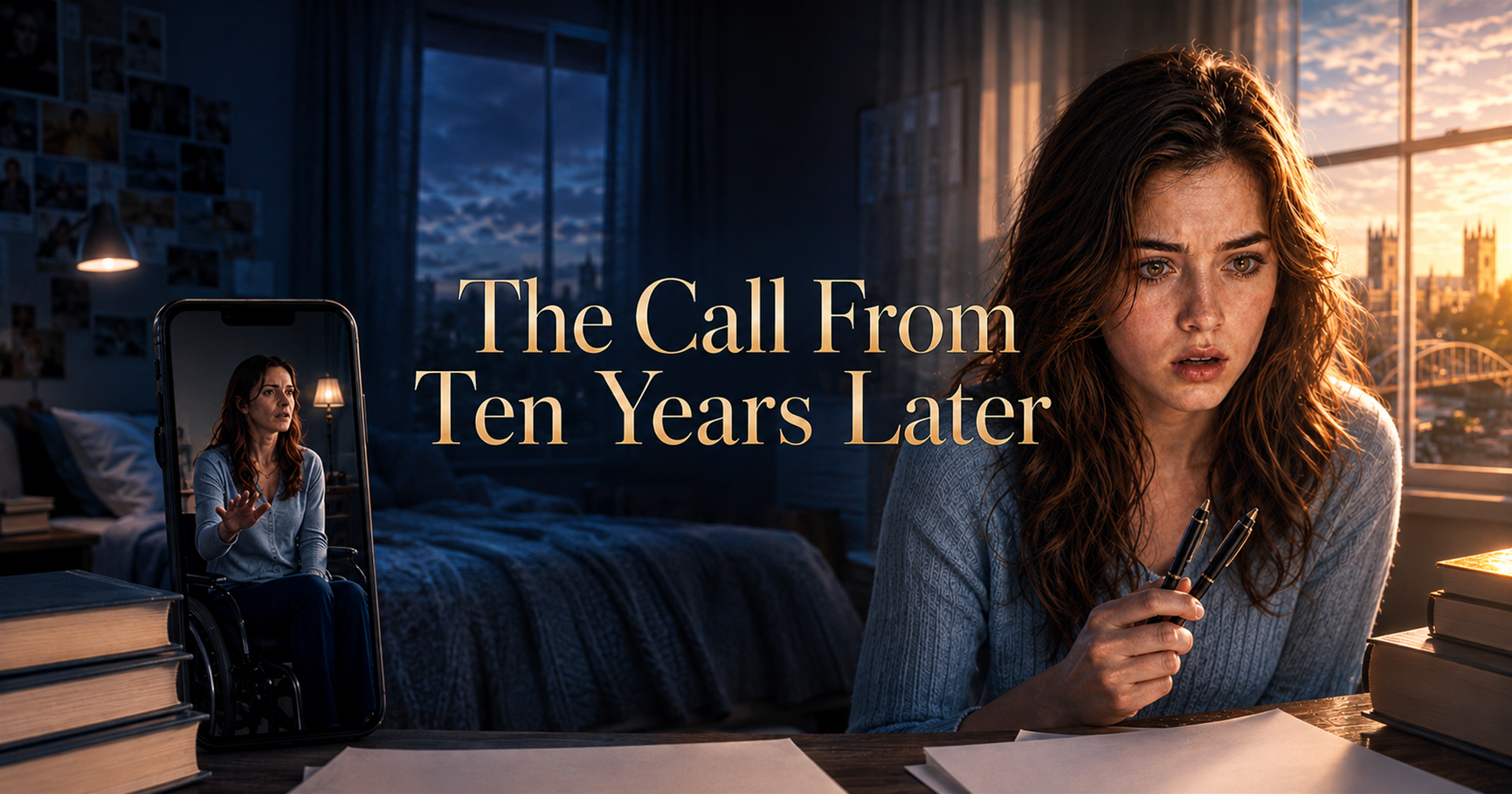
"The Call From Ten Years Later" Chapter 11 When the Ink Faded, I Chose Myself
Chapter 11
When the Ink Faded, I Chose Myself
For several seconds, neither of us spoke.
The woman on my screen wore a cream jumper and dark trousers. Her hair was shorter, her face fuller and her eyes alive with a light I had never seen in them.
She took one step towards the camera.
Then another.
“You can walk,” I whispered.
She laughed, and the sound broke into a sob.
“I can walk.”
I covered my mouth.
“The accident never happened,” she said. “When you changed the exam, you changed everything after it. I never went to London to find Julian. I never ran into that road.”
Behind her, city lights glowed through a wide window. Books and material samples filled the shelves.
“Where are you?”
“Manchester. I run a research team developing recyclable composites.” Her smile widened. “We received funding this morning.”
The future I had once imagined with Julian had not merely been restored. It had become something neither of us had known to imagine.
“Do you remember both lives?” I asked.
“Yes. The chair. The pain. Every year I spent hating them.” She looked down at her legs. “And I remember this life too. Oxford. My first laboratory. The first morning I woke up and realised I hadn't thought about Julian at all.”
A faint electronic pulse sounded.
We both recognised it.
“Is this the last call?”
She nodded.
Static shimmered at the edges of the picture.
“I used to believe I was calling to save you,” she said. “But you saved me. Not only from the accident. From building an entire life around what two people did to us when we were eighteen.”
Tears blurred the screen.
“We saved each other.”
“Then promise me one thing.”
“What?”
“From now on, live for yourself.”
The white static moved inward.
“I will.”
She lifted one hand to the screen. I pressed mine against the glass, our palms separated by ten years and no distance at all.
Then she disappeared.
The call remained in my history for two seconds. Letter by letter, the contact name faded until the line was blank.
Like disappearing ink.
This time, its disappearance did not frighten me.
It meant the warning was no longer needed.
One year later, summer returned to Oxford.
My first year had not transformed me into someone fearless. I still checked unfamiliar numbers before answering. Crowded roads sometimes brought a flash of pain to legs that had never been injured. Memory could leave bruises even when history changed.
But I had also presented research to a room full of academics, travelled alone and earned a place on a summer laboratory project. My life had expanded beyond the dimensions of the betrayal.
The legal agreement with Chloe remained in force. She had paid the agreed costs and posted the correction. Through Maya, I heard she had moved to Brighton and was working in a flower shop near the sea.
ADVERTISEMENT
One afternoon, a photograph arrived from an unfamiliar number. Chloe stood outside the shop holding sunflowers. Her hair was cut to her chin, and her smile was small but real.
There was no message asking for forgiveness.
I did not answer, but I did not delete the photograph either. Some endings did not need reconciliation. Distance could be mercy too.
Hannah confirmed that the photograph contained no demand or allegation. I asked her to note it and take no action.
Chloe's future was hers to rebuild. Mine did not require watching whether she succeeded.
Rachel was promoted to deputy editor and demanded dinner at a restaurant “expensive enough to honour the occasion”. Mum and Dad visited Oxford so often that Adrian claimed they knew the college porters better than I did.
Julian found new numbers occasionally.
The final message read: I'm in pain every day. Is that what you wanted?
I added it to the blocked-contact record and put my phone away.
His pain was not my victory. It was not my responsibility either.
I deleted the hidden folder where I had once reread his old love letters. I kept the legal evidence, because boundaries needed records, but removed the private relics that served only as doors into a room I no longer lived in.
The paper rose was the last thing I found. I did not burn it. I placed it in the recycling bin and watched it disappear beneath ordinary lecture notes.
Adrian sat opposite me in the library, sunlight falling across his open chemistry text. Over the past year, he had become my closest friend without ever demanding the title. He remembered my coffee order but never treated knowledge of me as ownership. When I needed silence, he shared it.
He placed an orange sweet at the edge of my notebook.
“Who was that?” he asked.
“Someone I used to know.”
“And now?”
I considered the question.
“Now he's a chapter that ended.”
Adrian nodded and returned to his book.
He did not ask whether I was over Julian. He did not ask what he might receive in return for waiting. He simply gave me room to choose.
I unwrapped the sweet, then took out the same brand of black pen I had carried into my A-Level examinations.
The barrel was scratched. Most of the lettering had worn away. The ink, however, still flowed cleanly.
On a sheet of paper, I wrote: Lunch with me?
I pushed it across the table.
Adrian read it, then looked up.
“Is that a scientific question?”
“It may require extensive testing.”
“In that case, I should clear my afternoon.”
I laughed.
Outside, bells rang over the city. Sunlight warmed the page between us, but the words did not fade.
For years, I had believed the most important love story of my life began with a boy, a paper rose and a promise.
I was wrong.
It began with a woman in a wheelchair who crossed ten years to tell me that I was still worth saving.
And it ended with me believing her.
THE END
ADVERTISEMENT
You May Also Like
-
CompletedChapter 12

Breaking the Ties of Love
Five years of marriage, five years of hell. Clara loved Xavier with every fiber of her being, but to him, she was nothing but a criminal—the monster who supposedly ruined his lover and crippled his sister. Locked away in a cold basement, Clara endured endless torment as penance for sins she never committed. But when the truth finally surfaces, Xavier falls to his knees, begging for a second chance. Too late. The Clara who loved him is already dead, and she is ready to walk into the darkness to escape him forever.Possessive Love|Love After Marriage|Second Chance|BE16.6k words5 41 -
CompletedChapter 12
Unloving You: A Rebirth of Letting Go
In his past life, Julian spent ten years chasing a woman who saw him only as a burden. He ruined her happiness, and in the end, she died saving him. Given a miraculous second chance, Julian wakes up on the very day of his 56th failed confession. This time, instead of flowers and pleading, he hands the bouquet to the man she truly loves. "I'm letting you go, Scarlett," he whispers. But as Julian packs his bags to disappear forever, the cold and powerful Scarlett begins to feel a suffocating panic. Why is the boy who once worshipped her now looking at her with such indifferent eyes?Glow-Up|Possessive Love|Fake Relationship|OE17.0k words5 38 -
CompletedChapter 20
Tainted Crown: A Tale of Sin and Sovereignty
Born in the freezing mud of the Lowlands, Solene learned early that survival has a price. When her mother trades their poverty for a place in Earl Dagon’s opulent mansion, Solene steps into a world of sparkling gems and deadly secrets. Behind her mask of a "Saint," she orchestrates a symphony of revenge, turning the imperial family into her puppets. The Prince, the Empire’s Golden Sun, thinks he can save her—but he is just another pawn in her cold-blooded game.Glow-Up|OE37.1k words5 43 -
CompletedChapter 13
The 999th Night: From Lovers to Strangers
After 999 nights of passion, Selina thought she was Julian's world. But to him, she was just a "placeholder" to kill time until his true love, Nina, returned. When a car crash forced him to choose, he protected Nina without a second thought, leaving Selina bleeding in the rain. Heartbroken and finally awake, Selina decides to vanish from his life forever. She books a one-way ticket across the ocean, leaving behind a decade of devotion. When Julian finally realizes that he can't live without his "shadow," all he finds is an empty house and a cold goodbye.Possessive Love|Second Chance|OE18.7k words5 40 -
CompletedChapter 16
The Profiler's Broken Silence
Clara was the most brilliant criminal profiler in the city, gifted with the power to expose any monster with her sketches. But her world shatters when her own husband, Sebastian, betrays her to protect the man who destroyed her family. After her hands are broken and her loved ones are gone, Clara realizes that love was just a gilded cage. Now, she doesn't want his apologies—she wants his downfall.Glow-Up|Possessive Love|Second Chance|BE17.9k words5 84