"She Tried to Kill Me—So I Destroyed Her Empire" Chapter 12
Maybe it had helped the case.
Maybe it had helped save my life.
It still broke something.
I didn't forgive him because he testified.
I didn't forgive him because he resigned from Whitmore Holdings.
I didn't forgive him because he gave up millions.
Forgiveness wasn't a reward for good behavior.
It was something we rebuilt one conversation at a time.
The first six months were ugly.
We argued.
We stopped speaking.
We started again.
I asked questions he hated answering.
He answered them anyway.
He asked whether I had ever loved him before I knew he was innocent.
I told him the truth.
"Yes."
Then I added, "But I didn't trust you."
That hurt him.
He stayed.
Eventually, staying began to mean something again.
"You ready?" he asked.
I looked toward the courthouse doors.
"As I'll ever be."
We went inside.
The hearing lasted less than forty minutes.
It was the final approval of the Whitmore Employee Restitution Trust.
Every verified pension loss had now been restored.
Not promised.
Not projected.
Restored.
Adrian had sold a large portion of his Whitmore Holdings shares to fund the final shortfall.
Richard contributed nearly everything he still controlled personally.
Insurance recoveries covered part.
Civil settlements covered more.
For the first time in years, the retirement accounts belonged completely to the people who had earned them.
After the judge signed the final order, an elderly man approached Adrian in the hallway.
I recognized him.
Thomas Bell.
Thirty-seven years with Whitmore Infrastructure.
He had appeared at almost every hearing.
He held out his hand.
Adrian looked surprised.
Then he shook it.
"My wife starts treatment next month," Thomas said.
Adrian swallowed.
"I'm glad."
"We couldn't afford it before."
"I'm sorry."
Thomas studied him.
"You didn't steal my pension."
"No."
"But your family almost made sure I'd never see it again."
Adrian nodded.
"I know."
Thomas released his hand.
"Then make sure you remember."
"I will."
He did.
Adrian never returned to the Whitmore board.
He kept enough shares to maintain financial independence, but he gave up voting control and refused every attempt to restore him as the public face of the company.
For the first time in his life, he introduced himself without mentioning Whitmore Holdings.
At first, people still recognized the name.
Eventually, that mattered less.
Richard disappeared from public life.
He sold Whitmore Estate.
The mansion on Beacon Hill went to a private educational foundation.
Margaret moved to a smaller house outside Graybridge.
She wrote me one letter.
It contained no excuses.
I kept it.
I never answered.
Graham Ashford's influence collapsed faster.
Once Nathan Price's records connected him to witness payments and evidence destruction, political friends stopped taking his calls.
His trial ended with convictions for obstruction and witness tampering.
Ashford Capital removed his name from its executive offices before sentencing.
Camille lost more than her freedom.
She lost the future she had designed.
ADVERTISEMENT
Twelve years.
No merger.
No Adrian.
No Ashford empire waiting for her when she returned.
Vanessa got eighteen.
She appealed twice.
She lost twice.
I never visited her.
Three years after the night at St. Catherine's, I left the Attorney General's Office.
Not because I was tired of investigations.
Because I wanted to choose who I investigated for.
The office I opened in South Harbor occupied the second floor above a neighborhood pharmacy.
Nothing about it looked powerful.
That was intentional.
The brass plaque beside the door read:
HAYES CENTER FOR FINANCIAL JUSTICE.
We were nonprofit.
We worked with people who couldn't afford private forensic accountants.
Women whose husbands emptied joint accounts before filing for divorce.
Older parents whose children secretly transferred property into their own names.
Immigrant families threatened by employers who controlled their wages.
Small-business owners destroyed by financial fraud.
People trapped by relatives who used money as a weapon.
People told that wealthy opponents had better lawyers, better connections, better chances.
I understood those sentences.
I'd heard versions of them myself.
On my first day as executive director, a young woman sat across from me clutching a folder.
"My brother says nobody will believe me."
I opened the folder.
"Why?"
"Because everything is in his name."
"That doesn't mean everything belongs to him."
"He has lawyers."
"So?"
She stared at me.
I smiled.
"Show me the money."
Six months later, she got her mother's house back.
That case meant more to me than seeing my name in any newspaper.
Susan cried when our center received its first major grant.
My mother had never cared about Whitmore money.
She had never cared that Adrian came from one of Graybridge's richest families.
The first time he came to her house after the trial, she handed him a bag of leaves and pointed toward the backyard.
"The gutters are clogged."
Adrian looked at her.
"I'm sorry?"
"You have arms."
I laughed so hard my ribs hurt.
He cleaned the gutters.
Susan approved of him after that.
Maybe that was why we got married in her garden.
There were twenty-seven guests.
No reporters.
No society photographers.
No corporate executives invited because their names belonged on a list.
Susan grew most of the flowers herself.
Rachel came.
Ruiz came.
Thomas Bell and his wife came.
Richard received an invitation.
He declined.
His note contained one sentence.
"This day should belong to what you built, not what I broke."
I understood.
Adrian wore a navy suit.
I wore a simple ivory dress.
No cathedral train.
No diamond spectacle.
No magazine deal.
When Adrian saw me at the end of the garden path, he cried before I did.
Afterward, while everyone was eating under strings of lights, Susan found me near the kitchen.
"There's something for you."
She handed me a small evidence box.
My name was written across the top.
I knew what it was before I opened it.
ADVERTISEMENT
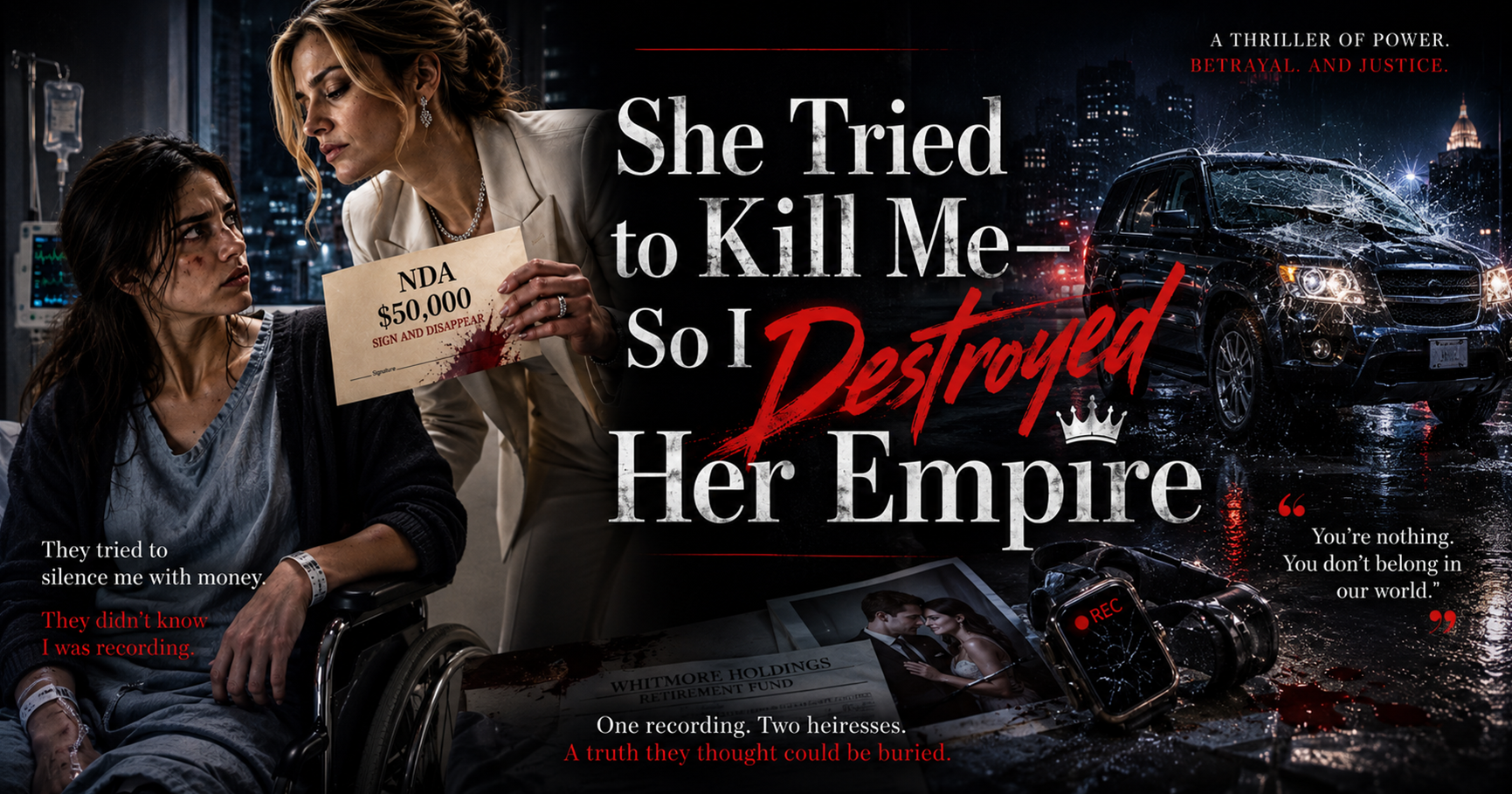
The smartwatch.
The screen was still shattered.
A crack ran diagonally across the glass from the place where Vanessa had slammed it against my wheelchair.
The band was torn.
The display would never turn on again.
Adrian came up behind me.
He saw the box.
For a moment, neither of us spoke.
"Does it still hurt to look at it?"
I touched the broken screen.
"No."
He watched me.
"Really?"
"Really."
I had once thought the watch represented the worst night of my life.
It didn't.
It represented the moment Vanessa discovered that power could not control evidence after the evidence had already left the room.
The following Monday, I donated it to the state's financial-crimes evidence training center.
They placed it in a secured teaching collection.
Young investigators would study the case.
They would learn how a live recording preserved evidence during an active threat.
They would learn how financial records connected an attempted murder to a pension-fraud conspiracy.
They would learn why evidence had to be duplicated, secured, authenticated, and followed without fear of the names attached to it.
I hoped they learned something else too.
Never confuse wealth with intelligence.
And never confuse power with innocence.
Years earlier, Vanessa had looked at my cheap clothes and South Harbor address and decided she understood me.
She thought people like me entered rooms only when people like her allowed it.
She thought Adrian's world was something I desperately wanted to join.
She never understood that I had already built a world of my own.
One Saturday morning, I left the Hayes Center after meeting with a new client.
The sun was bright over South Harbor.
People moved along the sidewalks carrying groceries and coffee.
A bus hissed to a stop at the corner.
My left leg still hurt sometimes.
That morning, it didn't.
Adrian was waiting across the street.
He lifted two coffees when he saw me.
I smiled but didn't cross immediately.
For one moment, I stood alone in the sunlight.
I thought about the wheelchair.
The hospital room.
The blood on the NDA.
The broken watch.
The thirty-eight million dollars.
Vanessa in handcuffs.
Camille behind glass.
Richard admitting what protection had cost.
Adrian walking away from the inheritance that had defined him.
And me.
Still here.
Vanessa had once told me to go back to where I belonged.
In the end, she lost her freedom.
Camille lost her empire.
The Whitmore family lost the shield their name had given them for generations.
I took nothing from them.
I didn't need to.
I only made sure the truth could be seen.
Then I stepped off the curb and walked toward Adrian.
No wheelchair.
No cane.
No one holding me up.
Vanessa had tried to make me disappear because she thought money made her untouchable.
She was wrong.
Money could buy silence. It could buy lawyers. It could even buy loyalty.
But it couldn't erase a ledger.
And it couldn't erase me.
END
ADVERTISEMENT
You May Also Like
-
CompletedChapter 12

Unloving You: A Rebirth of Letting Go
In his past life, Julian spent ten years chasing a woman who saw him only as a burden. He ruined her happiness, and in the end, she died saving him. Given a miraculous second chance, Julian wakes up on the very day of his 56th failed confession. This time, instead of flowers and pleading, he hands the bouquet to the man she truly loves. "I'm letting you go, Scarlett," he whispers. But as Julian packs his bags to disappear forever, the cold and powerful Scarlett begins to feel a suffocating panic. Why is the boy who once worshipped her now looking at her with such indifferent eyes?Glow-Up|Possessive Love|Fake Relationship|OE17.0k words5 30 -
CompletedChapter 20
Tainted Crown: A Tale of Sin and Sovereignty
Born in the freezing mud of the Lowlands, Solene learned early that survival has a price. When her mother trades their poverty for a place in Earl Dagon’s opulent mansion, Solene steps into a world of sparkling gems and deadly secrets. Behind her mask of a "Saint," she orchestrates a symphony of revenge, turning the imperial family into her puppets. The Prince, the Empire’s Golden Sun, thinks he can save her—but he is just another pawn in her cold-blooded game.Glow-Up|OE37.1k words5 34 -
CompletedChapter 16
The Profiler's Broken Silence
Clara was the most brilliant criminal profiler in the city, gifted with the power to expose any monster with her sketches. But her world shatters when her own husband, Sebastian, betrays her to protect the man who destroyed her family. After her hands are broken and her loved ones are gone, Clara realizes that love was just a gilded cage. Now, she doesn't want his apologies—she wants his downfall.Glow-Up|Possessive Love|Second Chance|BE17.9k words5 64